Three-way sedge
Dulichium arundinaceum
Description
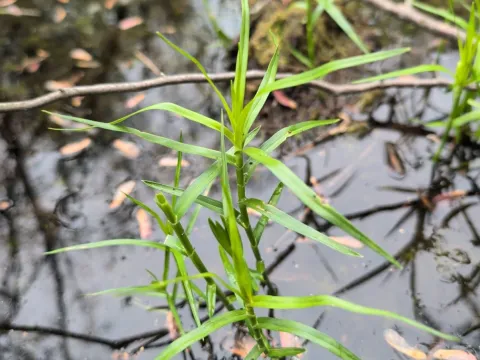
Three-way sedge (Dulichium arundinaceum) is a perennial herbaceous plant belonging to the Cyperaceae family. It is the only species within the genus Dulichium, noted for its bamboo-like appearance and its unique growth habit in aquatic and semi-aquatic environments across North America.
Native to North America, this species thrives in wetlands, swamps, riverbanks, and lake margins. Its natural range stretches across much of the eastern and central parts of the continent. The plant has successfully adapted to managed landscapes, becoming a popular choice for gardeners and landscapers focusing on pond environments and water-feature edge stabilization.
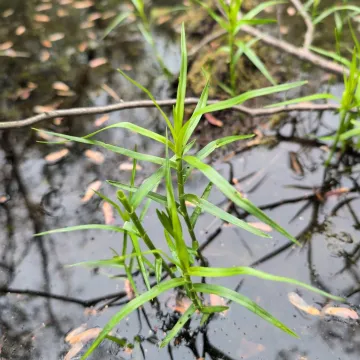
Botanically, the plant features a spreading rhizome system that supports erect, leafy stems growing up to 100 cm tall. The leaves are flat and arranged in three distinct ranks along the stem, which explains the common name. The flowers are clustered in spikelets that emerge from the leaf axils, providing a distinct and structural appearance throughout the late summer months.
Cultivation requirements for Dulichium arundinaceum are strictly centered on moisture availability. It performs best in nutrient-rich, moist, or water-saturated soils. It can be planted in shallow water, generally at depths up to 15 centimeters. In terms of light, it favors full sun but adapts well to partial shade, provided the root zone remains consistently damp.
- Propagation: Rhizome division during the dormant season.
- Soil type: Peaty, slightly acidic, or neutral marshy substrates.
- Temperature: Hardy in most temperate zones.
- Maintenance: Controlling the spread by thinning the rhizomes.
- Biosecurity: Generally resistant to pests and diseases.
The primary use for the Three-way sedge is ornamental landscaping in aquatic gardens and naturalized pond designs. It serves as an excellent plant for erosion control along water edges and contributes to the biodiversity of man-made wetlands. It is rarely affected by significant diseases or pests, making it a low-maintenance and reliable choice for water-feature planting projects.
Photo gallery