Dwarf glasswort
Salicornia bigelovii Torr.
Description
Dwarf glasswort (Salicornia bigelovii) is an annual herbaceous halophyte belonging to the Amaranthaceae family. Unlike traditional crops, this plant is uniquely adapted to high-salinity environments and can thrive by utilizing seawater, making it a valuable asset for agriculture in saline-prone regions.
The plant is native to the coastal regions of North and Central America. Its cultivation area includes arid coastal zones and saline desert lands where conventional farming is hindered by high salt concentrations, effectively utilizing resources that are typically unsuitable for food or fuel production.
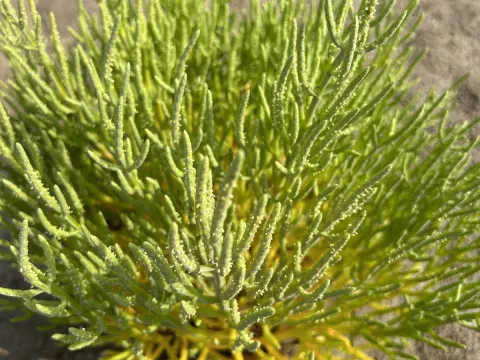
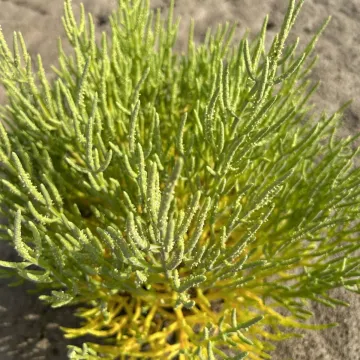
Botanically, it is a succulent with segmented, leafless stems that resemble green coral. As the plant matures, its color shifts from bright green to deep red or brown. It exhibits a shallow root system, requiring careful management of water availability to ensure optimal growth and seed maturation throughout the season.
The crop requires high temperatures and long, sunny days to achieve maximum biomass. Agronomic practices involve controlled irrigation with saline water and precise spacing to avoid overcrowding, which can encourage disease development. The plant is essentially a facultative halophyte, meaning it performs best when salt is present in the growing medium.
The primary economic and industrial applications include:
- Production of vegetable oil for biodiesel and other industrial fuels.
- Use as a forage crop for livestock in regions where fresh water is unavailable.
- Human consumption, specifically as a nutritious sea vegetable.
- Phytoremediation, helping to leach or extract salts from degraded saline soils.
Common plant health issues include root rots, which often occur when drainage is poor or humidity levels remain consistently too high. Pests typically include aphids and moth larvae, which can damage the tender, succulent tissues of the stem and affect overall yield during the flowering and seed-filling stages.
Photo gallery