Squirting cucumber
Ecballium elaterium
Description
The squirting cucumber (Ecballium elaterium) is a perennial herbaceous plant belonging to the Cucurbitaceae family. Unlike other members of the gourd family, it lacks tendrils and is famous for its explosive seed dispersal mechanism, which allows the plant to distribute its seeds over several meters when the fruit is disturbed at maturity.
Native to the Mediterranean region, North Africa, and Western Asia, this plant thrives in arid and semi-arid environments. It is often found growing in waste areas, roadsides, and rocky terrains. In an agricultural context, it is occasionally cultivated for its chemical compounds, which have been studied extensively for their pharmacological potential in traditional and modern medicine.
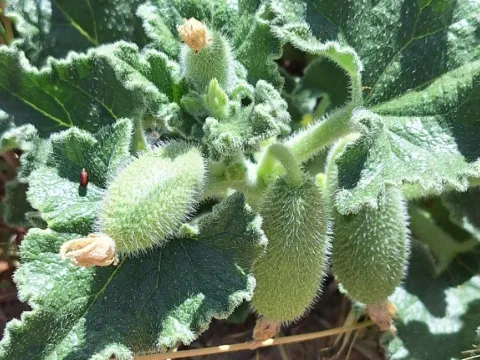
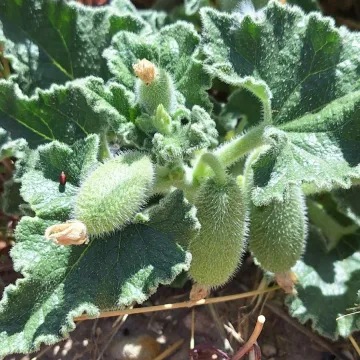
Botanically, the plant is characterized by its triangular, rough-textured leaves and small, yellow, bell-shaped flowers. The most distinct feature is the fruit, a fleshy, hairy berry that becomes highly pressurized as it ripens. The internal osmotic pressure triggers a forceful release of the seeds along with a mucilaginous liquid, a phenomenon that has garnered scientific interest in the field of plant biomechanics.
Cultivation of the squirting cucumber is straightforward due to its drought-tolerant nature. It prefers well-drained, sandy or gravelly soil and requires full sun exposure to flourish. It can be easily grown from seeds sown in early spring. Little to no supplemental irrigation is needed once the plant is established, as it is naturally adapted to survive with minimal rainfall. Weed management during the seedling stage is recommended to ensure strong growth.
The primary economic use of the plant is in pharmacology. The fruits contain cucurbitacins, specifically elaterin, which are potent compounds with laxative and anti-inflammatory properties. Due to the high toxicity of these compounds, the plant must be handled with extreme care, and it is strictly contraindicated for internal use without medical supervision. It remains a fascinating subject for academic study and botanical collections.
- High environmental adaptability.
- Rapid, aggressive seed dispersal.
- Low nutritional and water requirements.
- Significant pharmacological value.
Photo gallery