Hedgehog grass
Echinaria capitata
Description
Hedgehog grass (Echinaria capitata) is an annual grass species belonging to the Poaceae family. While not a conventional crop in intensive agriculture, it is a significant plant in arid ecosystems, often studied for its ability to thrive in nutrient-poor environments.
The native distribution of this species spans across the Mediterranean basin, the Caucasus, and parts of Central Asia. It is primarily found in xeric habitats, such as rocky slopes, sandy plains, and dry grasslands where other more demanding species fail to persist.
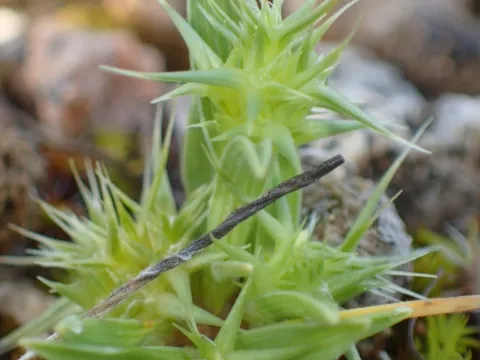
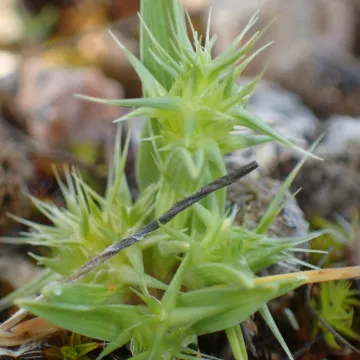
Botanically, Echinaria capitata is characterized by its distinct, dense, capitate inflorescence which is covered in stiff, spine-like glumes. These structures give the plant its characteristic hedgehog appearance. It typically reaches a modest height, forming small clumps that maximize water use efficiency.
In terms of cultivation and environmental requirements, the plant thrives in well-drained, sandy or gravelly soils. It possesses high salinity tolerance, making it a subject of interest for soil reclamation projects in degraded desert fringes where standard crops cannot be grown successfully.
The primary agricultural use of hedgehog grass is in extensive pasture management, where it provides early spring forage for sheep and goats. Beyond animal nutrition, its role in preventing soil erosion in arid climates makes it an important species for ecological restoration efforts.
- Poaceae family classification
- Annual life cycle
- Drought and salt tolerance
- Head-like inflorescence structure
- Soil stabilization capabilities
Photo gallery