Dahurian globe thistle
Echinops setifer
Description
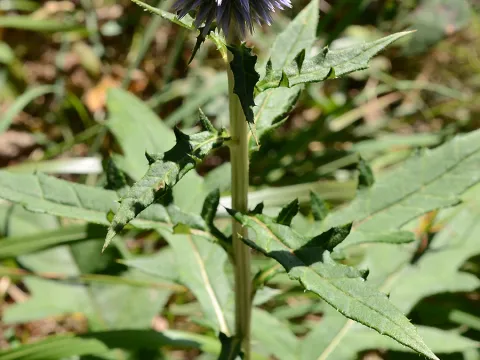
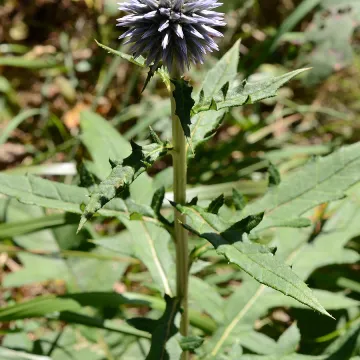
The Dahurian globe thistle (Echinops setifer) is a perennial herbaceous plant from the Asteraceae family. Known for its distinct spherical blue flower heads, this plant has gained attention as both a robust forage species for pollinators and a source of specialized chemical compounds for the pharmaceutical industry.
Native to East Asia, specifically regions spanning the Russian Far East, Mongolia, and Northern China, this plant is well-adapted to steppe ecosystems. Its evolutionary history in these dry and challenging environments has equipped it with strong resilience to both cold winters and summer droughts.
Botanically, the plant features a deep, strong taproot and upright stems that can grow up to 1.5 meters in height. The leaves are deeply serrated and possess sharp spines, providing defense against herbivores. The inflorescences are dense, spherical clusters of small, tubular flowers that exhibit a vibrant blue hue, blooming mid-to-late summer.
Successful cultivation requires well-drained, alkaline or neutral soils and plenty of direct sunlight. While it is hardy, young plants require management to prevent weed competition. Once established, the root system is highly efficient, minimizing the need for supplemental irrigation, though disease monitoring for fungal issues remains necessary in humid environments.
Economically, the Dahurian globe thistle is primarily valued as an excellent melliferous plant, often planted near apiaries to boost honey production. Furthermore, its seeds are harvested for the extraction of echinopsine, an alkaloid used in medical research for treating cardiovascular and neuromuscular disorders. It serves as a dual-purpose crop in modern agricultural systems.
- Exceptional nectar yield for apiaries.
- High drought tolerance once mature.
- Sensitivity to soil waterlogging.
- Susceptibility to powdery mildew in poor air circulation.
Photo gallery