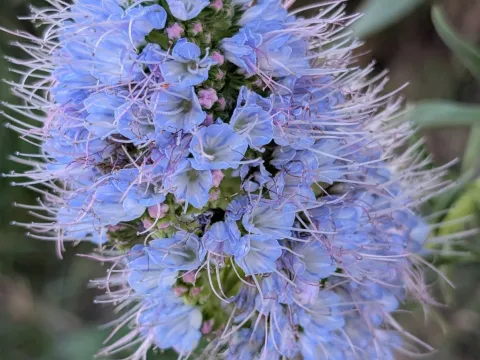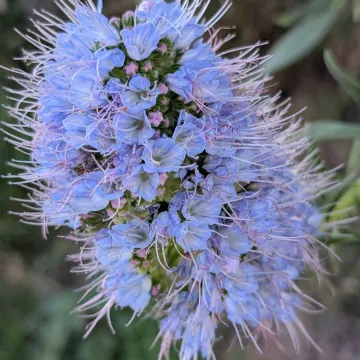
Madeira viper's bugloss
Echium nervosum
Description
Madeira viper's bugloss (Echium nervosum) is a perennial evergreen shrub belonging to the Boraginaceae family. Native to the Madeira archipelago, this plant is highly regarded in horticulture for its striking blue flowers and architectural structure. As a hardy plant, it thrives in environments that mimic its natural volcanic, rocky habitat, making it a unique addition to specific landscape designs.
Botanically, Echium nervosum is characterized by its woody base and a dense cluster of lanceolate leaves with prominent veins. The inflorescences are large, cylindrical, and composed of numerous small, tubular flowers that transition in color. This plant is known for its ability to grow in challenging conditions, including steep terrain and saline-affected environments near coastal zones.
Regarding climate and soil requirements, the plant prefers full sun and well-drained, porous soils. It is highly intolerant of waterlogged roots, which can lead to rapid decay. While it appreciates a moderate amount of moisture during its establishment phase, it becomes remarkably drought-tolerant once mature. It is best suited for USDA zones 9–11 and does not tolerate severe frosts.
Agrotechnical practices involve minimal fertilizer application, as the plant is adapted to nutrient-poor volcanic soils. Propagation is primarily achieved through seeds, which should be sown in a light, sandy medium. Periodic pruning of spent flower stalks is recommended to maintain the plant's shape and encourage a more compact growth habit for better aesthetic results.
- Excellent ornamental value for xeriscaping.
- Strong tolerance to coastal winds and salt spray.
- High potential as a pollinator-friendly plant.
- Low maintenance requirements once established.
The primary use of Echium nervosum is ornamental, frequently appearing in botanical gardens and Mediterranean-style landscapes. In terms of plant health, it is generally robust, but growers should be vigilant against root rot caused by improper drainage. Occasional infestations of sap-sucking pests like aphids may occur, which should be managed with standard horticultural practices.
Photo gallery