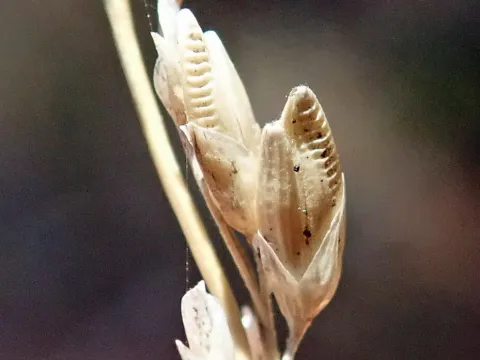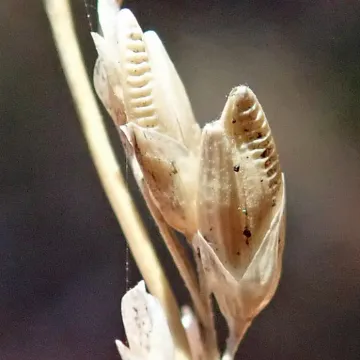
Veldt grass
Ehrharta erecta
Description
Veldt grass (Ehrharta erecta) is a perennial grass species belonging to the Poaceae family. While it is often classified as a weed due to its aggressive growth, it has historical significance as a forage resource and an adaptive plant in various agricultural landscapes across temperate and subtropical regions.
The species is native to South Africa, from where it has spread globally. Its successful naturalization in countries like New Zealand, Australia, and the United States is attributed to its ability to thrive in diverse ecological niches, particularly in disturbed areas and forest edges where other grasses fail to establish.
Botanically, it is a loosely tufted grass that grows to a height of 30–100 cm. The culms are slender, and the leaves are flat or slightly rolled with a distinct texture. One of its key biological traits is its rapid reproductive cycle, as it produces abundant seed crops throughout the year, especially under favorable moisture conditions.
In terms of agricultural requirements, Veldt grass is highly valued for its shade tolerance and soil adaptability. It can grow on a wide variety of soil types, from sandy to loamy textures. It responds well to moisture but can tolerate intermittent dry periods, making it a robust, though potentially invasive, ground cover in specific grazing management systems.
Management of this crop involves careful grazing control to prevent over-dominance. In intensive farming, it serves as a supplement in pasture mixes. Common pests include aphids and mites, while fungal pathogens may occur during prolonged humid spells, affecting leaf quality and overall biomass production for livestock.
Photo gallery