Annual veldtgrass
Ehrharta longiflora
Description
Annual veldtgrass (Ehrharta longiflora) is an annual grass species belonging to the Poaceae family. While often categorized as an invasive species in regions outside its native range, it maintains biological significance as a hardy, drought-tolerant grass that can thrive in various soil types.
Native to South Africa, the plant has established itself extensively in parts of Australia and North America. It is particularly well-adapted to Mediterranean-type climates, where it exploits winter and spring rainfall to complete its life cycle before the onset of the harsh, dry summer period.
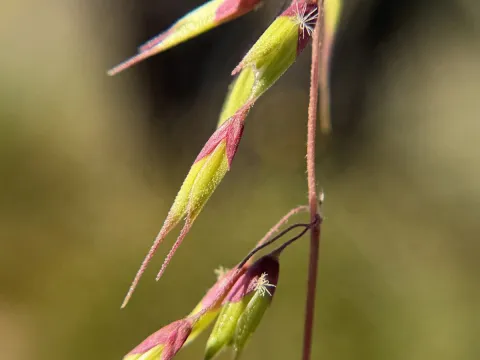
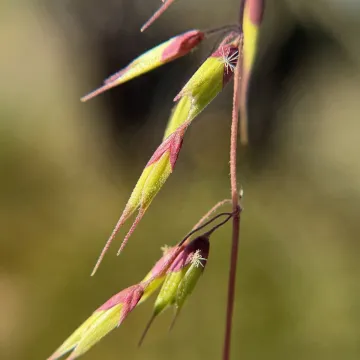
The morphology of this plant is defined by its slender, erect stems and distinct elongated spikelets, which are arranged in loose panicles. It reaches heights of 20 to 100 cm. Its ability to propagate solely through seeds makes it highly effective at colonizing disturbed areas, such as abandoned fields, roadsides, and coastal sand dunes.
Cultivation and management requirements for Ehrharta longiflora are centered on its adaptability to sandy, nutrient-poor soils. It does not require intensive fertilization, making it a low-input species. However, agricultural control is frequently necessary to prevent its spread into high-value grazing lands or protected native ecosystems, often involving early-season grazing or mechanical mowing.
In terms of agricultural utility, it can provide palatable early forage for livestock. Nevertheless, its primary management focus remains on containment. Potential threats to the plant include various rust fungi and leaf-spot diseases, as well as generalist herbivores that feed on the soft tissue of the growing grass.
Photo gallery