Indian goosegrass
Eleusine indica (L.) Gaertn.
Description
Indian goosegrass (Eleusine indica) is a robust annual grass belonging to the Poaceae family. While widely recognized as a problematic agricultural weed due to its extreme resilience, it also holds value as a forage plant in tropical regions and belongs to the same genus as some domesticated millet species used for food production.
Native to tropical and subtropical regions of Asia and Africa, this species has successfully naturalized across various continents. Its adaptability allows it to colonize diverse environments, ranging from fertile agricultural fields to compacted urban soils and disturbed wastelands, making it one of the most widespread grass species globally.
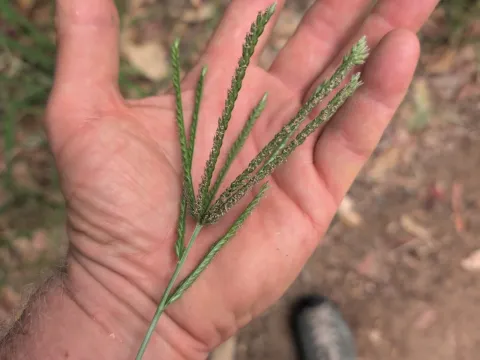
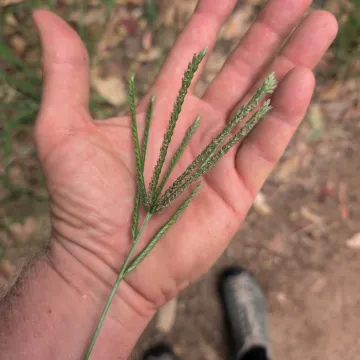
Botanically, it is characterized by its tufted growth habit and deep, fibrous root system that provides stability in compacted ground. The leaves are typically linear and flat, while the inflorescence is distinct, consisting of several spikes arranged in a finger-like pattern at the apex of the culm. This architecture is vital for distinguishing it from other similar grass species in the field.
The crop thrives in warm climates and is highly tolerant to heat and varying moisture conditions. Although it prefers sunny locations, it can tolerate partial shade. In terms of agronomy, it is noted for its ability to produce a massive amount of seeds in a single season. Effective control measures usually involve a combination of mechanical uprooting and selective herbicide application, as it has developed resistance to some common chemicals.
In terms of хозяйственное (economic) utility, Indian goosegrass is valued for its nutritional profile when grazed by livestock. In some subsistence farming systems, its seeds are harvested as a secondary grain source. However, its primary impact on agriculture remains its competitive nature against cash crops, necessitating diligent field management to prevent yield loss during the early growth stages of cultivated crops.
Common biological challenges include:
- Susceptibility to fungal pathogens during the rainy season, impacting the quality of the foliage.
- Infestations by stem-borers and other common grass pests that can stunt growth.
- The plant's high seed output, which necessitates early eradication before the seeds reach maturity.
Photo gallery