Bottlebrush grass
Elymus hystrix
Description
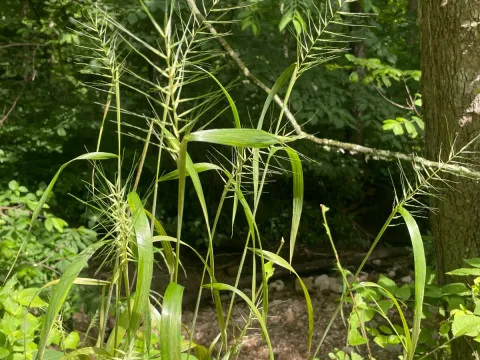
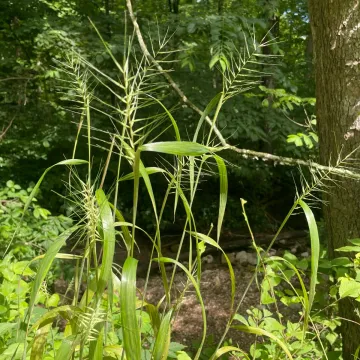
Bottlebrush grass (lat. Elymus hystrix) is a perennial grass belonging to the Poaceae family. It is a distinctive species known for its unique inflorescence shape and its ability to thrive in shaded environments where most other cereal or forage grasses would struggle to survive.
Native to North America, this plant is naturally found in woodland settings, forest margins, and rocky slopes. Because of its origin, the species is well-adapted to temperate climates. In modern agricultural practice, it is increasingly recognized for its role in sustainable land management and for its ability to integrate into forest-based agricultural systems.
Botanically, Elymus hystrix grows in loose clumps with stems reaching up to 1.5 meters. The most recognizable feature is the terminal spike, which consists of long, spreading awns that protrude like a bottle brush. The leaves are broad, bright green, and possess a coarse texture, which helps the plant maintain high efficiency in low-light conditions.
In terms of cultivation, it thrives in moist, well-drained, fertile soils. While it prefers partial shade, it is highly adaptable to various soil types, provided there is enough moisture. Agronomic management is relatively simple: it can be established through seed sowing in spring or fall and requires minimal maintenance once established, as it competes well against invasive weeds.
The main agricultural applications for Bottlebrush grass include erosion control, as its root system effectively stabilizes soil on slopes, and its inclusion in forage mixtures for wooded pastures. Aside from agriculture, it is frequently used in ecological restoration projects due to its resilience to pests and its general disease-resistant nature in its native habitats.
- Excellent shade tolerance
- Strong winter hardiness
- Erosion control properties
- Resistant to most common grass pests
Photo gallery