Southern threecornerjack
Emex australis Steinh.
Description
Southern threecornerjack (Emex australis Steinh.) is an annual herbaceous plant belonging to the Polygonaceae family. In the agricultural sector, it is recognized as a persistent and invasive weed that poses significant challenges to crop production, particularly in grain-growing regions and livestock pastures.
Native to Southern Africa, this species has successfully naturalized across various Mediterranean and semi-arid climates worldwide, most notably in Australia. Its ability to thrive in disturbed soils and degraded environments has allowed it to become a dominant weed species in many cropping systems and open grazing lands.
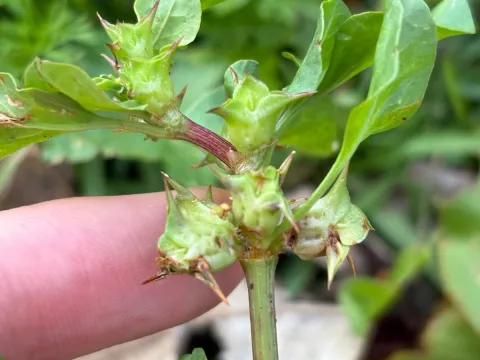
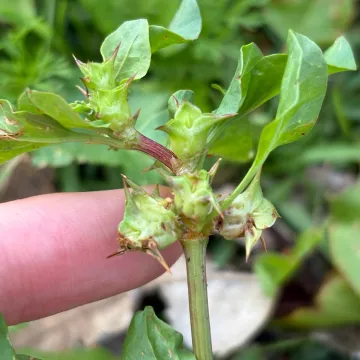
The plant is characterized by a strong taproot, prostrate or ascending stems, and triangular-shaped leaves. Its most distinctive feature is the spiny fruit, which creates severe problems by injuring the hooves of livestock and contaminating fleece or wool. These spines are extremely durable and can remain in the soil for several years, maintaining a viable seed bank.
Agronomically, Southern threecornerjack favors sandy and friable soils, demonstrating high drought tolerance. It competes aggressively with cereals and legumes for moisture, light, and nutrients. Effective management requires a combination of pre-emergent herbicide applications, crop rotation to suppress its growth cycle, and careful monitoring of seed dissemination routes.
While this plant is generally considered a nuisance, it is important to understand its biological cycle to implement effective control strategies. Typical pests and diseases associated with it are often studied within the framework of biological control programs, aiming to introduce natural enemies to reduce its population without relying solely on chemical inputs.
Photo gallery