Water horsetail
Equisetum fluviatile
Description
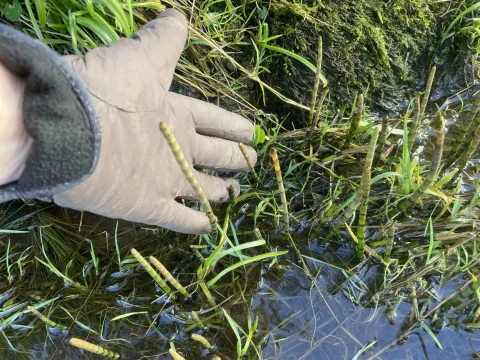
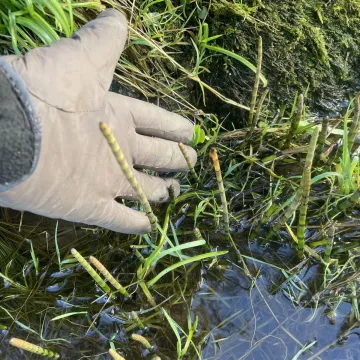
Water horsetail (Equisetum fluviatile) is a perennial spore-bearing herbaceous plant belonging to the family Equisetaceae. As a true hydrophyte, this species is uniquely adapted to aquatic and semi-aquatic environments, often dominating the littoral zones of lakes, slow-moving rivers, and marshy meadows.
The native range of the species encompasses the temperate and cool regions of the Northern Hemisphere, spanning across Europe, Asia, and North America. It is a vital component of wetland ecosystems, where it plays a critical role in stabilizing sediments and providing essential habitat for various aquatic microorganisms and invertebrates.
Botanically, the plant is characterized by hollow, smooth, and erect stems that are usually unbranched or sparsely branched, reaching up to 100 cm in height. The rhizome system is extensive and penetrates deep into the substrate, allowing the plant to form dense clonal colonies. Reproduction is facilitated by spores produced in apical cones during the spring season.
Cultivation of water horsetail requires conditions of permanent saturation or shallow standing water. It thrives in nutrient-rich silty soils. From an agronomic perspective, it is often regarded as a wetland indicator or a weed in drainage-managed land. Maintenance involves monitoring water levels and preventing excessive expansion, as the rhizomes are highly resilient to mechanical disturbance.
In terms of economic utility, water horsetail is primarily used in wetland restoration projects and as an ornamental plant for large-scale pond landscaping. There is also interest in its role in phytoremediation, as the plant effectively absorbs heavy metals and excess nutrients from water bodies. It has historically been used in limited applications due to its high silica content.
- Resilience to deep-water conditions.
- High biomass production in wetland environments.
- Low susceptibility to common fungal pathogens affecting crops.
- Significant potential for water filtration and purification.
Photo gallery