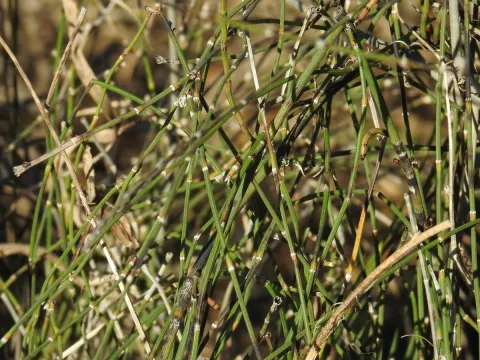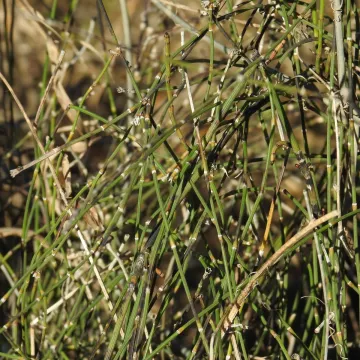
Branched horsetail
Equisetum ramosissimum
Description
Branched horsetail (Equisetum ramosissimum) is a perennial spore-bearing plant belonging to the Equisetaceae family. As a descendant of ancient plant lineages, this species possesses unique morphological and physiological traits that allow it to thrive in diverse and often harsh environmental conditions.
The native range of Equisetum ramosissimum spans across large regions of Eurasia and North Africa. It is frequently found in sandy areas, riverbanks, and degraded agricultural lands. In professional agronomy, it is often classified as a persistent weed due to its aggressive growth pattern and ability to colonize large areas rapidly.
Botanically, the plant is characterized by rigid, repeatedly branched stems that contain significant deposits of silica. Its root system is exceptionally deep, making it difficult to eradicate manually. Reproduction occurs via spores produced in terminal cones, although the plant relies heavily on its vegetative rhizome network for expansion and survival during stressful conditions.
Agricultural management requires a multifaceted approach. Because this species prefers acidic, moisture-rich soils, liming the soil can significantly reduce its competitive advantage. Deep mechanical cultivation remains the most common method of control, aimed at depleting the rhizome reserves by consistently removing the photosynthetic surface area throughout the growing season.
From a utilization perspective, the plant is studied for its chemical profile, including secondary metabolites like alkaloids and flavonoids. While it has historical applications in traditional medicine, its presence in pastures is often problematic as it can be toxic to livestock. Modern research continues to explore its potential in phyto-remediation due to its high mineral absorption efficiency.
- Highly drought-tolerant anatomy
- Presence of siliceous cell walls
- Deep, extensive perennial root system
- Rapid regeneration from rhizome segments
Photo gallery