Wood horsetail
Equisetum sylvaticum
Description
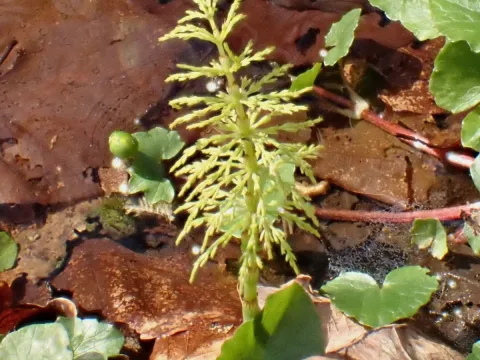
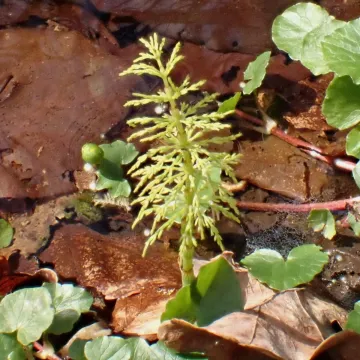
Wood horsetail (Equisetum sylvaticum) is a perennial, spore-bearing plant belonging to the Equisetaceae family. It is distinct from other horsetails due to its drooping, secondary branches, which give the plant a delicate, lacy appearance often compared to a miniature pine tree. It is a hardy species well-adapted to specific temperate forest environments.
Originating throughout the Northern Hemisphere, this plant is native to moist forests across Europe, Asia, and North America. In agricultural settings, it is rarely cultivated as a crop but is frequently encountered as a persistent weed in low-lying, poorly drained pastures and field margins. It serves as an ecological indicator of soil acidity and moisture saturation.
The biology of Equisetum sylvaticum involves a complex underground rhizome system that supports both fertile and sterile stems. The plant reproduces primarily through spores produced on terminal strobili during early spring. Its ability to spread vegetatively via rhizomes makes it an extremely robust colonizer in habitats that meet its environmental preferences.
Regarding cultivation and habitat requirements, the wood horsetail thrives in acidic, humus-rich, and damp soil conditions. It requires consistent moisture throughout the growing season and prefers shaded or semi-shaded locations. To manage its presence in agricultural fields, farmers typically focus on soil pH adjustment through liming and improving field drainage to make the environment less hospitable.
While often treated as a problematic weed in commercial farming, the plant has historical significance in herbalism. It contains high levels of silica, which has been traditionally utilized in folk remedies. However, caution is advised, as like other horsetail species, it can be toxic to horses and livestock if ingested in large quantities during grazing.
- Distinctive branched stem structure.
- Indicator of acidic, wet soils.
- High silica content.
- Spore-based and rhizomatous reproduction.
Photo gallery