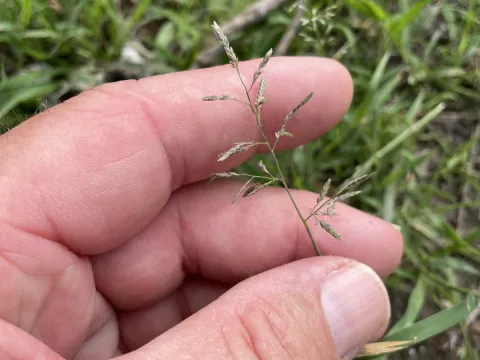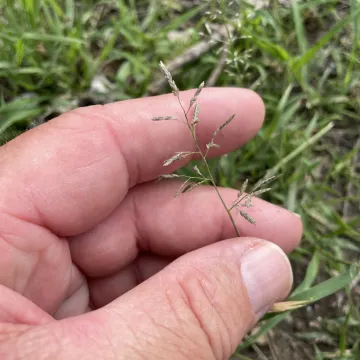

Mediterranean lovegrass
Eragrostis barrelieri
Description
Mediterranean lovegrass (Eragrostis barrelieri) is an annual grass species belonging to the Poaceae family. Known for its remarkable resilience, this plant is frequently studied for its ability to thrive in harsh, nutrient-poor environments where standard agricultural crops would typically fail to establish.
Originating from the Mediterranean basin and arid regions of Africa and Asia, this species has successfully naturalized in many semi-arid zones worldwide. It prefers open, disturbed habitats and is commonly found in sandy or gravelly soils where competition from taller, more demanding vegetation is absent.
The botanical morphology of the plant features tufted stems that are generally slender and reach heights of 10 to 40 centimeters. The leaves are narrow and often exhibit a rough texture. The inflorescence is a distinct, loose panicle with spikelets that are pressed close to the axis, a specific trait that differentiates it from other Eragrostis species.
In terms of climate and soil requirements, Mediterranean lovegrass is highly drought-tolerant and performs best in full sun exposure. It displays a high tolerance for poor-quality soils, including those with low nitrogen levels or high salinity. While it does not require intensive management, it benefits from minimal moisture during the germination phase to ensure a stable stand.
Agriculture-wise, its primary value lies in its use as a pasture grass in regions with limited vegetation cover. It acts as a reliable fodder source for small ruminants in arid environments and can play a role in soil stabilization efforts against erosion. Despite being considered a weed in some cropping systems, its role in reclaiming marginal lands is of significant ecological interest.
- Extreme drought resistance.
- Excellent performance in sandy soils.
- Low requirement for fertilizers.
- Rapid biomass production in favorable weather.
Photo gallery