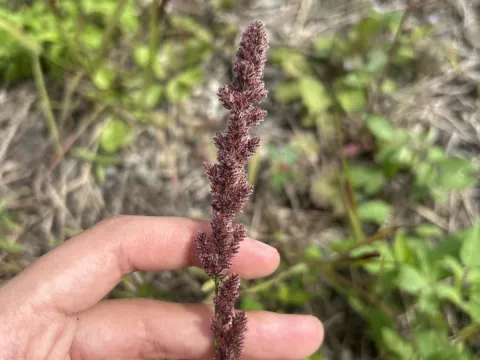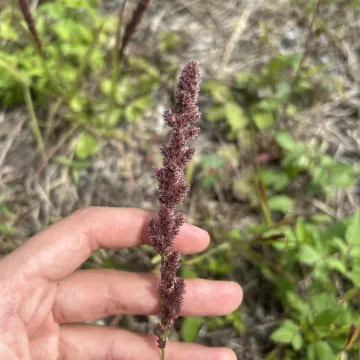
Fringed lovegrass
Eragrostis ciliaris
Description
Fringed lovegrass (Eragrostis ciliaris) is an annual grass species belonging to the Poaceae family. It is a highly resilient plant, often found in tropical and subtropical regions where it plays a significant role in ground cover and livestock forage production.
Native to Africa and parts of Asia, this species has naturalized in many tropical regions globally. It thrives in open, sunny locations and is often observed colonizing sandy or disturbed soils, showing remarkable tolerance to low-fertility environmental conditions.
From a botanical standpoint, the plant is characterized by its tufted growth habit and narrow, cylindrical inflorescences. The spikelets are densely packed and adorned with small, fine hairs, which give the panicle a distinct, feathery, or "fringed" appearance, identifying the species among other grasses.
The cultivation requirements for this species are centered on warm, frost-free climates. It is highly drought-tolerant and performs well on poor-quality soils where more demanding crops fail. Agricultural management involves rotational grazing practices that encourage vegetative growth and minimize the development of lignified, stemmy material that is less palatable to livestock.
In terms of agricultural utility, it is primarily used as pasture forage. While it may not provide the massive bulk of intensive forage species, its stability in dry seasons and ability to regrow under harsh conditions make it a valuable asset for pastoral systems in arid and semi-arid environments.
- Excellent adaptation to sandy and acidic soils.
- Effective erosion control in disturbed areas.
- High tolerance to heat and solar radiation.
- Low requirement for fertilizers and chemical inputs.
Photo gallery