Blue fleabane
Erigeron acris
Description
Blue fleabane (Latin: Erigeron acris) is a herbaceous plant belonging to the Asteraceae family. In agricultural and botanical contexts, it is recognized as a resilient perennial or biennial that plays a significant role in various ecological habitats, often acting as a pioneer species in disturbed soils.
The origin of this plant traces back to the temperate regions of the Northern Hemisphere, spanning across Europe, Asia, and North America. It is commonly found in meadows, grassy slopes, and woodland edges, where it thrives by occupying gaps in existing vegetation and responding dynamically to local soil conditions.
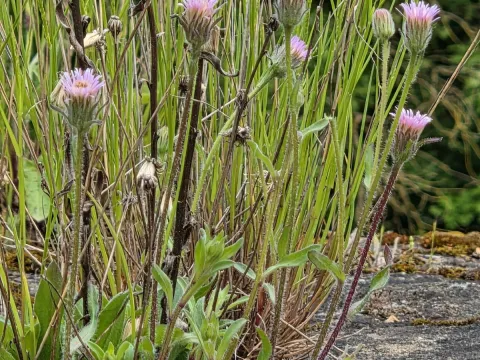
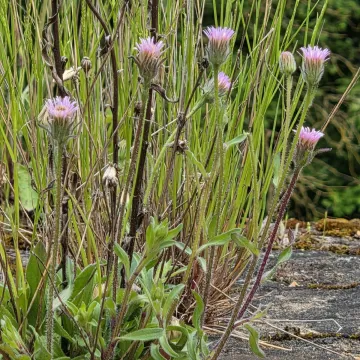
Botanically, Erigeron acris is characterized by its erect, often reddish stem that can grow up to 60 cm in height. The foliage is generally lanceolate, and the flowers are arranged in clusters of small, daisy-like heads with yellow discs and purple or pinkish ray florets. Its root system is primarily taproot-based, allowing for nutrient uptake from diverse soil profiles.
Regarding cultivation and agronomy, the plant is undemanding, showing high tolerance to varying levels of soil acidity and moisture. While it is not typically grown as a commercial agricultural crop, it is often managed as a weed in fields, requiring preventative measures such as timely mowing or soil cultivation to prevent the widespread dispersal of its wind-borne seeds.
Economically, Blue fleabane has a long-standing history in traditional medicine, particularly for its antiseptic and astringent properties derived from the chemical compounds in its leaves and flowers. It is also a subject of interest for integrated pest management, as it can occasionally harbor beneficial insects that contribute to the overall biological balance of an agricultural site.
Photo gallery