Crowned eryngo
Eryngium coronatum
Description
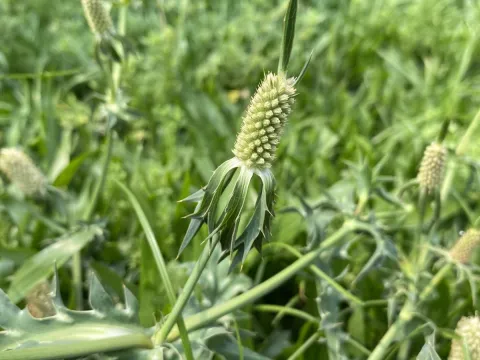
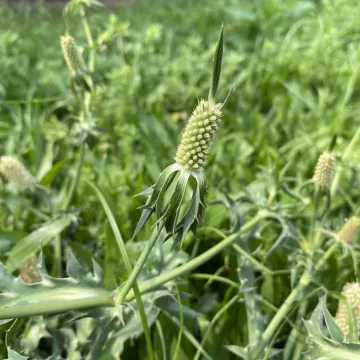
Crowned eryngo (Eryngium coronatum) is a perennial herbaceous plant belonging to the family Apiaceae. It is a highly specialized ornamental crop that is valued for its distinct, metallic-colored floral heads and structural appearance, making it an excellent candidate for both garden design and the commercial dried flower market.
Native to arid and semi-arid regions of Southwest Asia, the plant has adapted to survive in harsh environmental conditions. In agricultural practice, it is cultivated in regions that mimic its natural habitat, requiring minimal water once established. Its distribution is primarily focused on regions where late summer blooms can be harvested for floral export.
Botanically, the plant is characterized by a strong taproot, allowing it to thrive in poor soils. The stems are rigid and branched, supporting spiny, leathery leaves and compact, rounded inflorescences. These inflorescences are surrounded by bracts that contribute to the plant's distinctive, ornate appearance, which persists even after the plant has matured.
Agrotechnical requirements focus on soil drainage and sun exposure. Crowned eryngo thrives in sandy, well-draining soils with a neutral to slightly alkaline pH. Over-fertilization should be avoided, as it leads to weak stems and reduced flower color intensity. Regular weeding during the first year of growth is crucial to prevent competition from more aggressive weeds.
The main commercial utilization is in the floriculture industry, specifically as a premium dry-flower component. Regarding pathology, the crop is generally resilient, though it is susceptible to root rot in waterlogged conditions. Pest pressure is minimal, provided that the crop management plan includes proper spacing to ensure airflow and reduce fungal risks.
Photo gallery