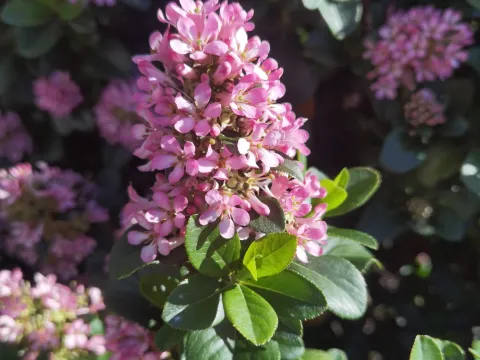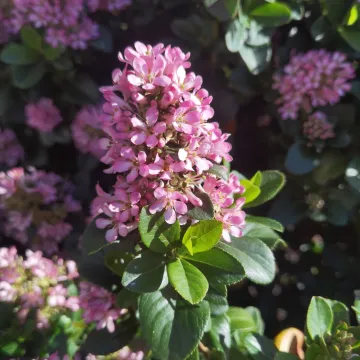
Escallonia laevis
Escallonia laevis (Vell.) Sleumer
Description
Escallonia laevis is a distinctive evergreen shrub belonging to the Escalloniaceae family. Known for its lush foliage and vibrant flowers, it is widely appreciated in temperate climates as a fundamental element for hedging, screening, and ornamental garden displays.
The species is native to South America, with its primary distribution centered in Brazil. Throughout its natural habitat, it thrives in environments that provide consistent moisture and mild temperatures. In cultivation, it has become a staple for coastal gardens where it can tolerate salty air and mild maritime winters, though it requires protection in regions prone to heavy frost.
Botanically, this shrub features smooth, glossy, ovate leaves that remain dense throughout the year. During the summer, it produces clusters of fragrant, tubular flowers that attract pollinators. The plant’s growth habit is sturdy and upright, making it highly suitable for structural planting and formal design, as it responds exceptionally well to repeated pruning.
Agricultural requirements for Escallonia laevis focus on well-draining soil and a sunny or partially shaded location. It performs best in nutrient-rich, slightly acidic to neutral soils. While it appreciates moisture during the growing season, it is crucial to ensure that the soil does not become waterlogged, as this is a primary factor in root stress.
- Regular pruning after flowering to maintain shape.
- Application of balanced slow-release fertilizer in early spring.
- Mulching around the base to retain moisture during summer heat.
- Winter protection in colder zones using fleece or greenhouse cover.
In terms of agricultural and horticultural use, it serves primarily as a decorative hedge or a screen. The main pests affecting this species include aphids and spider mites, which can be managed with biological or systemic insecticides. Diseases such as leaf spot are typically managed by ensuring adequate spacing between plants to promote airflow and reducing overhead irrigation.
Photo gallery