
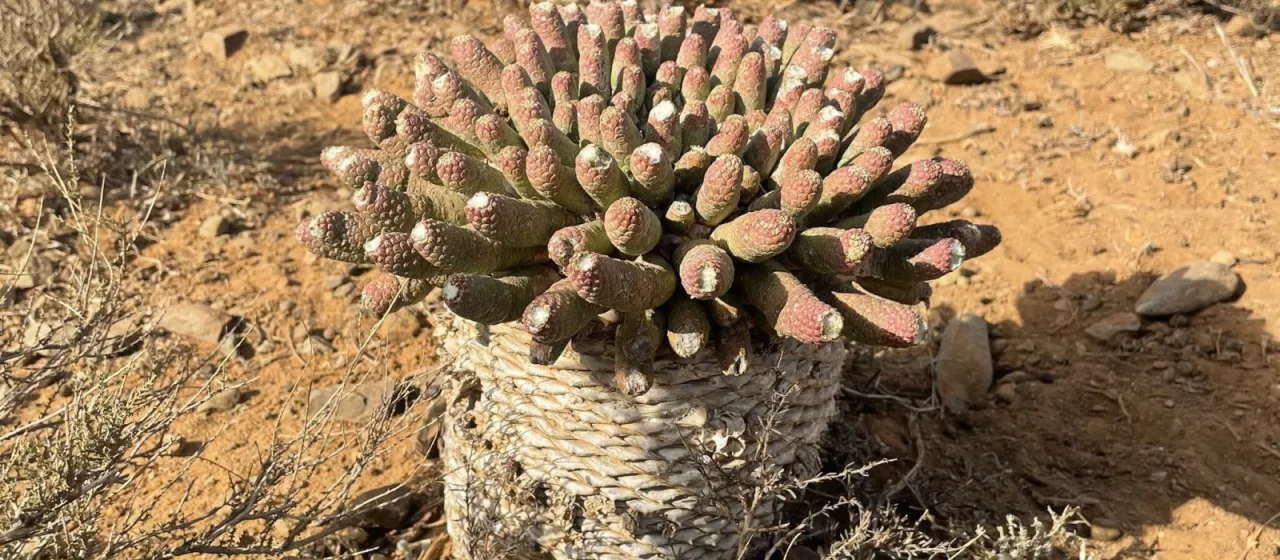
Description
Edible spurge (Euphorbia esculenta) is a succulent perennial plant belonging to the Euphorbiaceae family. This species is native to arid regions and is distinguished by its fleshy, moisture-storing stems that allow it to thrive in nutrient-poor and water-scarce environments. Unlike many other members of the genus, it has historically been recognized for its utility in subsistence agriculture.
The plant originates from the arid areas of South Africa, specifically within the Cape region. It is well-adapted to habitats with high solar radiation and low rainfall. The geographic distribution of the species is strictly limited to climates that lack heavy frost and prolonged dampness, as the plant requires distinct periods of dryness to maintain its health and physiological balance.
Botanically, Euphorbia esculenta is characterized by a condensed growth habit, forming a succulent mound with a robust root system. Its stems are armed with spines to deter herbivores, and like all Euphorbias, it contains a specialized latex. The small inflorescences, known as cyathia, are typical of the family and are evolutionarily adapted to ensure pollination in desert ecosystems.
Cultivation of this crop requires strict attention to soil composition and water management. It demands extremely well-draining, sandy, or stony substrates. In an agricultural setting, the primary challenge is preventing root rot, which necessitates a precise watering schedule that mimics the natural intermittent rainfall of its native environment, combined with high levels of natural light.
The economic and historical use of the plant primarily involves the consumption of its processed edible parts, which requires careful preparation to remove latex compounds. In modern research, the plant is gaining attention for its potential as a drought-tolerant crop capable of growing on marginal land where traditional agricultural practices are not feasible, highlighting the importance of studying its resilient biology.
- High adaptation to arid climates.
- Requirement for sandy, well-draining soils.
- Moderate nutrient needs.
- Sensitivity to soil saturation.
- Important subject for xerophytic research.