
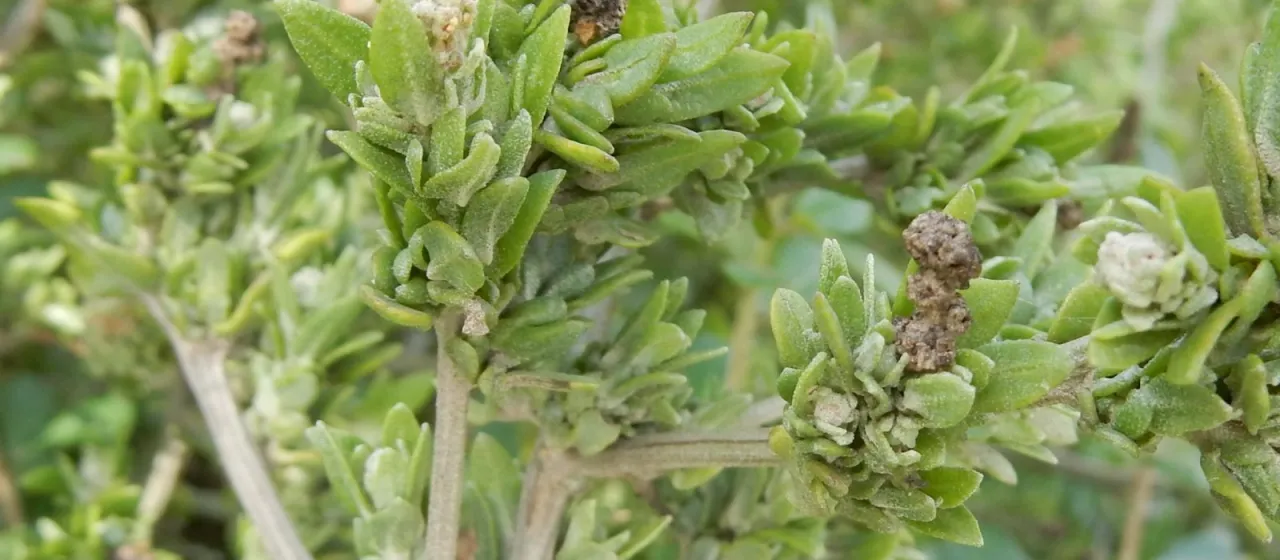
Description
Exomis microphylla is a perennial shrub belonging to the Amaranthaceae family. In agricultural and environmental sciences, this species is recognized for its exceptional resilience in saline environments and semi-arid conditions, making it a valuable candidate for land rehabilitation and secondary forage production in challenging climates.
Native to Southern Africa, the plant has evolved to thrive in coastal and desert ecosystems. Its natural distribution demonstrates a remarkable ability to survive in environments characterized by high salinity and low precipitation. Its success in these regions has led to international interest in its use for the ecological restoration of degraded landscapes.
Botanically, the plant is characterized by its dense, branching structure and small, fleshy leaves often covered in a characteristic bloom. The root system is highly adapted to search for deep soil moisture, which grants the plant significant drought resistance. Its reproductive cycle is well-timed to maximize seed production even under limited water availability.
The cultivation requirements for Exomis microphylla prioritize well-drained, sandy or loamy soils. It requires full sunlight to maintain its structural integrity and metabolic activity. Unlike many other crops, it thrives in saline soils where traditional agricultural species fail. Maintenance is relatively low, focusing mainly on the prevention of waterlogging, which the plant is highly intolerant of.
Economically, the crop serves as a reliable forage source for livestock in arid regions, providing essential nutrients when other grazing resources are scarce. Beyond its feed value, it is widely used in soil conservation programs to prevent erosion by wind and water. By stabilizing the soil surface and improving its chemical properties, the plant facilitates the recovery of biodiversity in fragile habitats.
- Exceptional salt tolerance for saline soil management.
- High survival rate in low-rainfall environments.
- Effective erosion control on sandy substrates.
- Low input costs due to natural hardiness.