Ferocactus wislizeni
Ferocactus wislizeni (Englm.) Britt. & Rose
Description
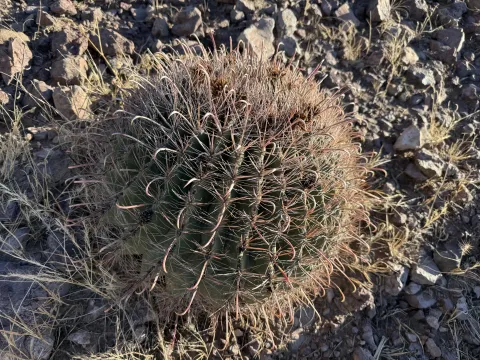
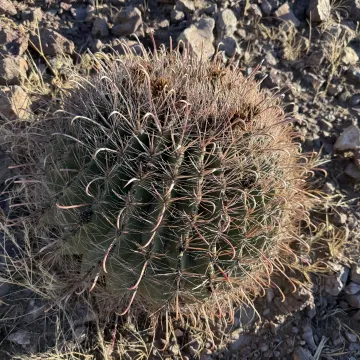
Ferocactus wislizeni, commonly known as the Fishhook Barrel Cactus, is a prominent member of the Cactaceae family. It is highly valued in horticulture for its massive, cylindrical stature and its striking, heavily armed spines, making it a focal point in xeriscaping projects and arid-climate botanical collections.
The species is native to the Sonoran and Chihuahuan Deserts of North America, stretching across Arizona, New Mexico, and Northern Mexico. In its natural habitat, it thrives in open, rocky slopes and alluvial plains, enduring harsh desert conditions characterized by extreme heat, intense solar radiation, and erratic, scarce precipitation cycles.
Botanically, the plant is distinguished by its deep ribs and formidable, hooked radial and central spines. As the plant reaches maturity, it can grow quite tall, sometimes exceeding two meters. During the blooming season, usually mid-summer, it produces vibrant, funnel-shaped flowers ranging in color from pale yellow to deep orange-red, crowning the top of the stem.
Cultivation requires strict adherence to agrotechnical standards: high light intensity is non-negotiable for proper growth and spine development. The growing medium must be highly permeable, utilizing mineral-based substrates with significant proportions of pumice, grit, and coarse sand. Over-watering is the primary cause of failure, as the plant demands significant dry periods between irrigation events.
While relatively robust, the species is susceptible to specific pathological and environmental stresses. Agronomists and growers should monitor for the following issues:
- Root and stem rot caused by poor soil aeration or excess soil moisture.
- Infestations of mealybugs and spider mites, particularly in greenhouse environments.
- Etoliation or stretching of the stem due to insufficient light levels during the active growth period.
Photo gallery