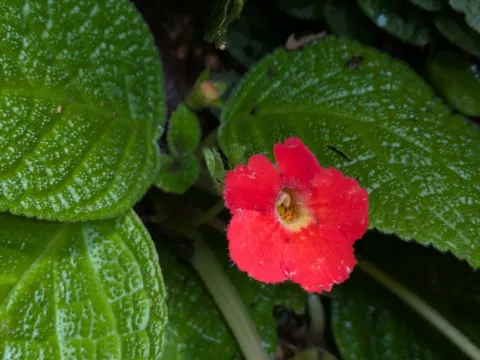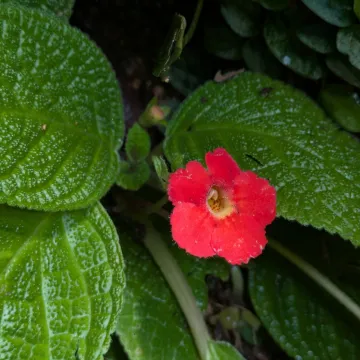
Flame violet
Episcia cupreata (Hook.) Hanst.
Description
Flame violet (Episcia cupreata) is a perennial herbaceous plant belonging to the Gesneriaceae family. This species is highly valued in the ornamental plant industry for its stunning, bronze-toned, textured foliage and vibrant, tubular flowers that create a sophisticated visual appeal in indoor settings.
The plant originates from the tropical rainforests of Central and South America, specifically regions in Colombia, Venezuela, and Brazil. In its natural habitat, the flame violet thrives as a ground cover or epiphyte under the dense forest canopy, which dictates its preference for filtered light and high atmospheric humidity.
Botanically, the plant is characterized by its stoloniferous growth habit, meaning it produces runners that root at the nodes upon touching the soil. The leaves are opposite, ovate, and typically covered in fine hairs, giving them a velvety texture. Its tubular flowers, often in shades of bright red or orange, provide a stark contrast against the dark, patterned foliage.
Agricultural and horticultural requirements for flame violet involve maintaining stable temperatures above 18°C. It requires a well-draining, slightly acidic substrate that stays consistently moist but never waterlogged. High humidity is crucial for maintaining the vigor of the plant, and growers often use pebble trays or humidifiers to ensure the environment mimics its tropical origin.
Flame violet is primarily cultivated for interior decoration, hanging baskets, and terrarium displays. While it is a relatively resilient plant, it is susceptible to certain physiological issues and pests, requiring consistent monitoring to maintain plant health:
- Mealybugs
- Aphids
- Spider mites
- Root rot caused by poor drainage
Photo gallery