
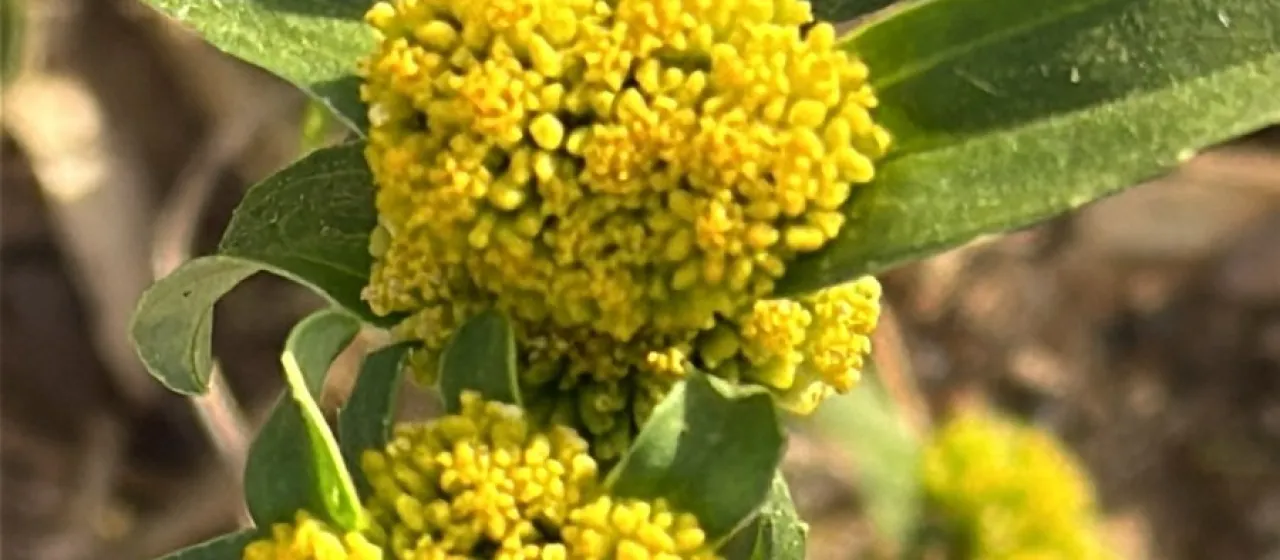
Description
Flaveria australasica Hook. is an annual herbaceous plant belonging to the Asteraceae family. It is widely recognized in scientific circles not primarily as an agricultural crop, but as a crucial model organism for studying the physiological and biochemical pathways of photosynthesis, specifically the C4 carbon fixation pathway.
Native to Australia, this species is typically found in arid and semi-arid regions. Its natural habitat includes floodplains, dried-up riverbeds, and saline soils, indicating a high tolerance for environmental stressors such as drought, high temperatures, and soil salinity. These ecological traits make it a subject of interest for climate-resilient crop research.
The plant features a branching, erect stem and opposite leaves. Its most distinctive botanical characteristic is its yellow, head-like inflorescences. The structural organization of these flowers and leaves supports its survival in open, high-light intensity environments where it acts as a primary producer in its ecosystem.
The main scientific significance of Flaveria australasica lies in its C4 photosynthetic mechanism. By comparing this species with closely related C3 plants, researchers have made significant breakthroughs in understanding how plants evolved to be more efficient in water and nitrogen use. This information is invaluable for developing future agricultural biotechnologies.
- Adaptive to high temperatures.
- Significant saline tolerance.
- Crucial research model for C4 metabolism.
- Limited pest pressure due to specialized chemistry.
Regarding its interaction with the environment, the plant is relatively resistant to common pests, though local insects can cause minor damage to foliage. It does not require intensive agricultural management, as it is perfectly adapted to the nutrient-poor and harsh soils of the Australian outback, functioning as an indicator of specific hydrological conditions in its native range.