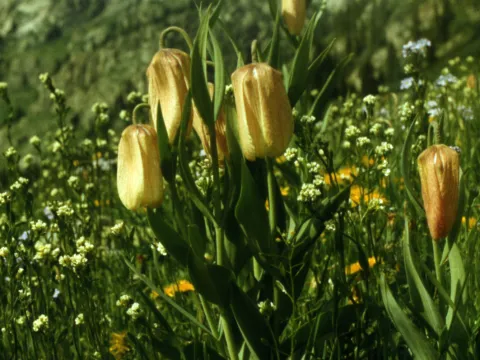

Pale-flowered fritillary
Fritillaria pallidiflora
Description
The pale-flowered fritillary (Fritillaria pallidiflora) is a notable bulbous perennial belonging to the Liliaceae family. It is recognized both for its elegant appearance in ornamental horticulture and its traditional pharmacological significance, which stems from the alkaloids present within its fleshy bulbs.
This species is native to the mountain regions of Western China and Central Asia. It typically thrives in alpine meadows and rocky slopes, where it has evolved to withstand seasonal climate fluctuations. Its natural resilience makes it a suitable candidate for cultivation in various temperate climatic zones, provided that specific soil conditions are met.
Botanically, the plant is characterized by a sturdy stem reaching 50–80 cm, adorned with lanceolate leaves. The inflorescence consists of bell-shaped, nodding flowers that exhibit a soft, pale-yellow or cream color with subtle green veins. The bulb is composed of distinct, nutrient-rich scales that enable the plant to undergo dormancy during unfavorable seasons.
Agrotechnical requirements focus on well-draining, fertile, and slightly alkaline soil. The pale-flowered fritillary is highly sensitive to waterlogging; therefore, planting on slopes or in raised beds with added gravel/sand is highly recommended. Optimal cultivation involves autumn planting at a depth of about 10–15 cm, ensuring the bulbs are protected from intense summer moisture and provided with adequate air circulation.
The economic value of this crop is twofold. First, it serves as an ornamental plant for rock gardens, prized for its early blooming and unique aesthetics. Second, it serves as a source for medicinal research, as the bulbs contain compounds used in traditional remedies for respiratory ailments, making it a niche but important agricultural product in certain regions.
Plant health management is essential to prevent common issues such as Fusarium wilt and gray mold, which are primary threats in humid conditions. Pests, most notably the lily beetle (Lilioceris lilii), can cause severe damage to foliage. Integrated pest management, involving regular monitoring and early intervention with biological or chemical controls, is critical for maintaining crop yield and aesthetic quality.
Photo gallery