
Description
Fumaria parviflora, commonly known as fine-flowered fumitory, is an annual herbaceous plant belonging to the Fumariaceae family (or Papaveraceae in contemporary classifications). While often managed as a weed in modern agricultural landscapes, it possesses significant botanical interest and historical importance due to its biochemical properties.
The plant originates from the Mediterranean region but has established a broad distribution across Europe, Western Asia, and North Africa. It is highly adaptable, frequently colonizing disturbed areas, including arable fields, orchards, and roadsides, where it benefits from the nutrient-rich conditions typically found in cultivated environments.
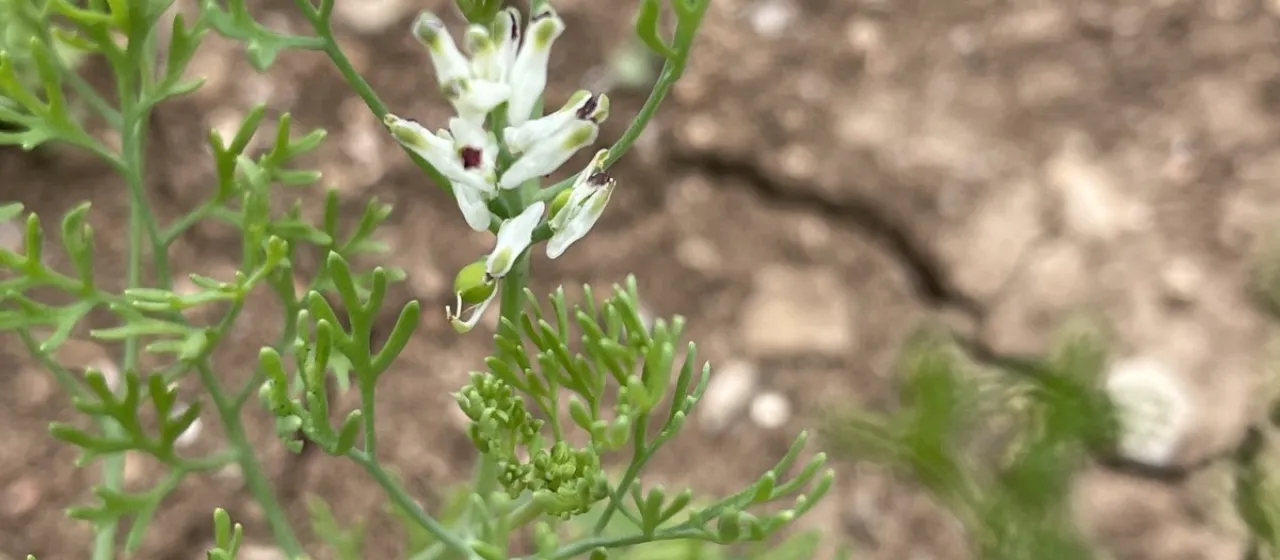
Botanically, Fumaria parviflora is distinguished by its slender, often trailing stems and finely dissected, glaucous leaves. The small, tubular flowers, which typically appear in white or pale pink shades with dark-tipped petals, form distinct racemes. This specific floral morphology is critical for accurate identification in field surveys.
Regarding cultivation and environmental requirements, the plant thrives in well-drained, fertile soils with a preference for sunny locations. It is a competitive species that can rapidly colonize crop rows if not managed, drawing nutrients and moisture that would otherwise support primary crops. Its rapid life cycle allows it to set seeds quickly, making it a persistent component of the weed seed bank.
Beyond its status as an agricultural pest, the plant is valued for its secondary metabolites, including fumaric acid and isoquinoline alkaloids. These compounds are utilized in pharmaceutical applications for their hepatoprotective and anti-inflammatory properties. Sustainable management involves a combination of mechanical weeding, crop rotation, and precise herbicide application to minimize impact on yield.
- Crop rotation: interrupting the life cycle of the weed.
- Mechanical weeding: utilizing timely inter-row cultivation.
- Herbicidal control: using selective chemical treatments.
- Monitoring: assessing population density before the flowering stage.