
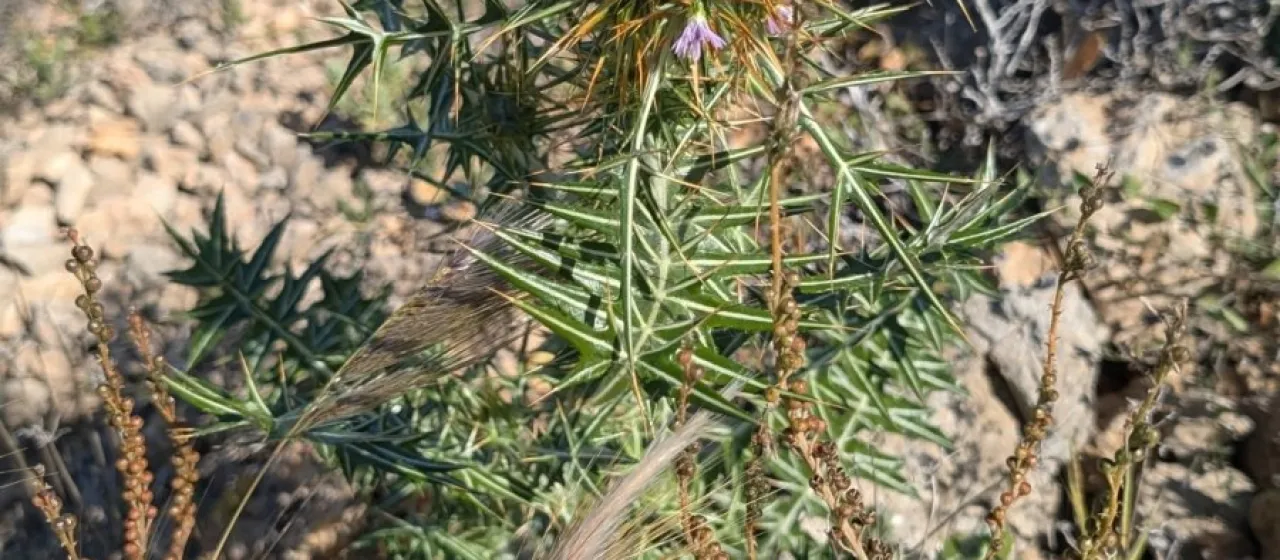
Description
Galactites duriaei is a herbaceous plant belonging to the Asteraceae family. While it is not a primary industrial crop, it serves as a resilient species in its native Mediterranean habitats, possessing significant biological adaptations that allow it to thrive in nutrient-poor and arid environments where many conventional crops fail.
The plant is native to the Mediterranean basin and North Africa. It is commonly found in rocky areas, abandoned fields, and arid hillsides. Its natural distribution is a testament to its evolutionary success in environments characterized by long, hot summers and unpredictable rainfall patterns, making it a focus for studies on drought-resistant vegetation.
Botanically, Galactites duriaei is distinguished by its spiny bracts and pinnately lobed leaves, which often feature white marble-like veining. The plant forms a basal rosette during the vegetative phase and produces erect stems crowned with floral heads. These morphological traits serve as a deterrent to herbivores and minimize transpiration during peak heat.
Regarding agronomic requirements, this species demands well-drained, porous soils, preferably with a high mineral content and alkaline pH. Cultivation success depends on minimizing soil compaction and ensuring full sun exposure. It is highly resistant to heat stress, though it may be susceptible to root rot if waterlogged conditions persist during the early establishment phase.
The agricultural and economic utility of Galactites duriaei primarily lies in its potential for land reclamation and pasture improvement in degraded Mediterranean landscapes. Furthermore, its nectar-rich flowers make it an excellent choice for supporting pollinator populations within agricultural settings. Typical pests include aphids and specialized leaf miners, though the plant's robust nature allows it to recover well under balanced management.
- Exceptional drought tolerance.
- Adaptability to calcareous, stony soils.
- Important role in supporting local pollinator diversity.
- Low requirement for chemical inputs.