
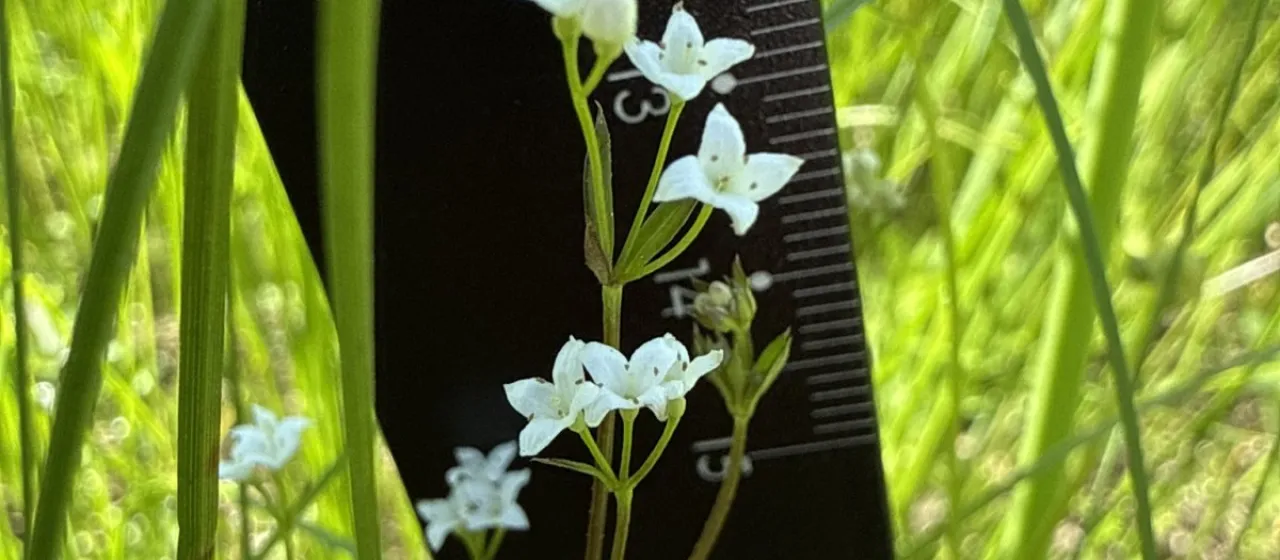
Description
Fen bedstraw (Galium uliginosum) is a perennial herbaceous plant belonging to the Rubiaceae family. While not a conventional agricultural crop, it is a significant component of wetland vegetation and damp meadow ecosystems across the temperate regions of Eurasia.
The plant thrives in habitats characterized by constant moisture, including fens, marshes, wet grasslands, and stream banks. Its native range extends across a vast territory, where it serves as a natural indicator of high groundwater levels and soil saturation. It is adapted to various soil types, provided the moisture levels remain high throughout the growing season.
Botanically, Fen bedstraw is characterized by its slender, four-angled stems that are often weak and tend to lean on surrounding vegetation. The leaves are linear-lanceolate and arranged in whorls of 6 to 8 around the stem nodes. Small white flowers form dense, terminal cymes, creating a delicate appearance during the flowering period from early to mid-summer.
In terms of ecological requirements, this species demands constant moisture and is intolerant of prolonged drought. It prefers nutrient-rich or slightly acidic soils that remain damp. In agricultural settings, it is treated as a component of wild hay meadows rather than a managed crop, and its presence can sometimes be a sign that soil drainage may be insufficient for traditional grain cultivation.
Regarding its utility, Fen bedstraw is primarily valued as part of natural grazing pastures, contributing to the overall diversity of the vegetation. It is not typically targeted by specialized agricultural pests because it does not form monocultural plantations. Its role is strictly ecological, providing structure to marshy habitats and supporting local biodiversity within the grassland ecosystem.
- Highly adaptive to saturated soil conditions.
- Features characteristic whorled leaf arrangement.
- Spreads through an extensive creeping root system.
- Serves as a bio-indicator for wetlands and bogs.