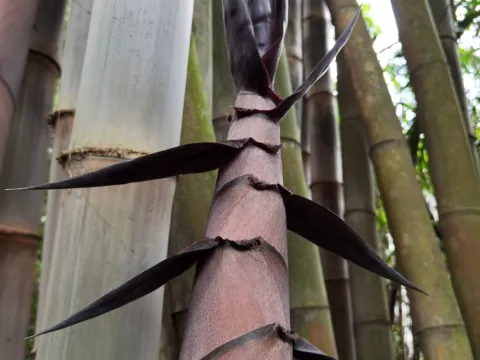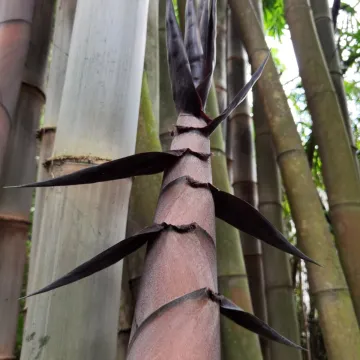

Rough giant bamboo
Dendrocalamus asper (Schult. & Schult. f.) Backer ex K. Heyne
Description
Rough giant bamboo (Dendrocalamus asper) is a prominent species within the Poaceae family, widely recognized for its impressive stature and structural utility. Often called the king of bamboos, it forms dense, clump-forming groves that can reach soaring heights, making it a vital resource for tropical agriculture.
Native to Southeast Asia, specifically regions like Indonesia, Thailand, and Malaysia, this species thrives in tropical climates characterized by high humidity and consistent rainfall. Its natural range has expanded significantly due to its adaptability to various tropical latitudes, where it is now cultivated for both local food supply and industrial applications.
Botanically, it is defined by its substantial, thick-walled culms which exhibit a rough texture due to tiny hairs on the outer epidermis. It thrives in well-drained loamy soils and requires substantial nitrogen levels for optimal growth. It is highly sensitive to waterlogging, necessitating planting sites with excellent drainage capacity to maintain a healthy rhizome system.
Agronomic management involves periodic thinning of older culms to allow younger shoots to receive adequate sunlight and nutrients. Propagation is generally achieved through vegetative methods such as offset planting or branch cuttings, as flowering in this species is infrequent and unpredictable, making seed-based propagation rare in commercial operations.
The economic impact of this bamboo is extensive:
- Culinary use: Shoots are highly sought after as a nutritious vegetable, being a key ingredient in many traditional cuisines.
- Construction and engineering: Its tensile strength makes it an ideal material for scaffolding, structural beams, and flooring.
- Crafts and pulp: The fibers are extensively used in high-quality paper production and artisanal handicraft manufacturing.
Regarding health management, the crop is susceptible to specific pests such as the bamboo borer and various fungal pathogens that thrive in humid stagnant conditions. Sustainable management practices, such as maintaining optimal plant spacing and removing decaying biomass, are critical for ensuring long-term plantation vigor and minimizing the need for chemical interventions.
Photo gallery