Creeping lady's-tresses
Goodyera repens
Description
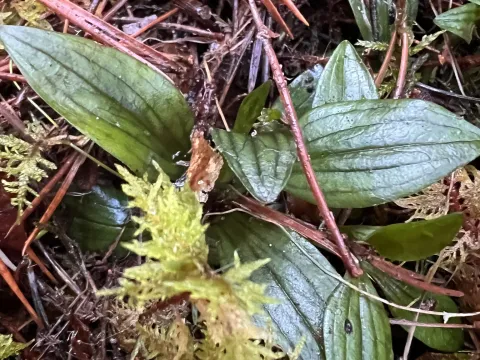
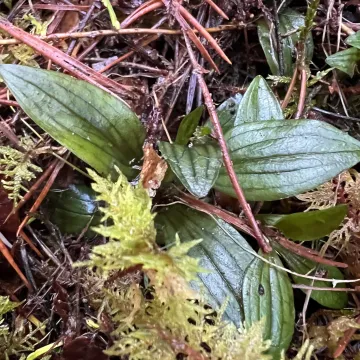
Creeping lady's-tresses (Goodyera repens) is a perennial herbaceous plant belonging to the Orchidaceae family. It is one of the few orchid species adapted to the cool temperate climates of the Northern Hemisphere, where it typically thrives as an evergreen component of coniferous forest floors.
The origin and distribution of this plant span across vast regions of Europe, Asia, and North America. It is typically found in mature forests where the soil is rich in organic matter and leaf litter. Its survival is intrinsically linked to mycorrhizal fungi in the soil, which assist in nutrient uptake, making it a highly specialized plant in its natural environment.
Botanically, the plant is identified by its creeping rhizomes and rosettes of leaves featuring a distinct reticulated or netted white pattern. During the flowering stage, it produces a spike-like inflorescence consisting of small, white or greenish-white flowers that are delicately scented. The growth habit is slow, reflecting its adaptation to low-light conditions.
Cultivation requirements are strict, as the plant demands stable humidity, acidic soil, and high levels of organic humus. Agronomists note that it is difficult to maintain in traditional agricultural systems due to the complex relationship between the plant's root system and soil microorganisms. Artificial propagation usually requires tissue culture techniques or inoculation of the substrate with specific fungi.
In terms of economic and practical use, the plant is primarily studied for its medicinal properties and utilized in specialized gardening for shaded woodland displays. Pest management is critical, as the plants are susceptible to slug damage and root rot if the drainage is insufficient. Careful monitoring of the microclimate is essential to prevent physiological stress in controlled environments.
Photo gallery