
Description
Hiptage (botanical name: Hiptage benghalensis) is a perennial woody climber belonging to the Malpighiaceae family. Renowned for its vigorous growth, this plant can develop into a massive, trailing, or climbing shrub. In many tropical landscapes, it serves as an attractive feature due to its ability to cover large structures such as pergolas and trellises.
The species is native to tropical Asia, ranging from India to China and across Southeast Asia. It thrives in diverse habitats including tropical forests, riverbanks, and woodland fringes. Due to its adaptability and rapid growth, it has been introduced to various parts of the world, though in some tropical regions, it is managed as an invasive species due to its competitive nature.
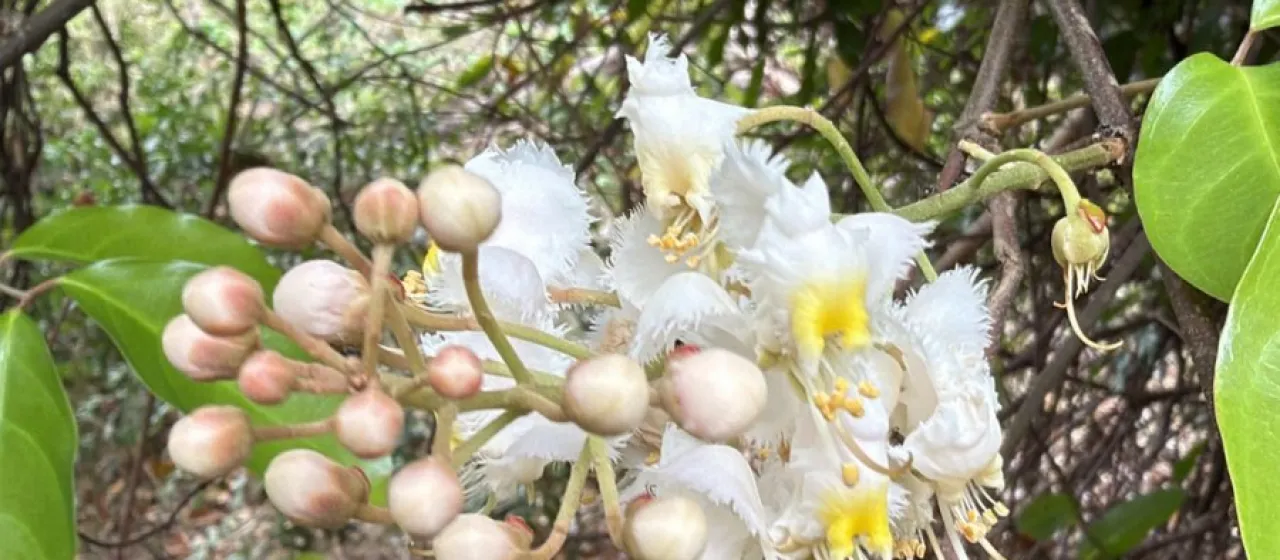
Botanically, the plant is characterized by its large, leathery, opposite leaves and spectacular, fragrant racemes of flowers. The flowers typically feature five petals, often white or pinkish-white with a yellow blotch at the base. Following pollination, the plant produces winged samaras (fruits), which utilize wind dispersion to propagate seeds effectively across natural environments.
Regarding cultivation, the plant requires specific environmental conditions to thrive. It performs best in nutrient-rich, well-draining soils with a neutral or slightly acidic pH. While it is drought-tolerant once established, optimal growth occurs with consistent moisture and high ambient humidity. Full to partial sun exposure is essential for maintaining strong stem development and abundant seasonal flowering.
Management of the plant involves regular pruning to keep the vine within its desired space and promote denser foliage and floral displays. Potential pests include spider mites and scale insects, particularly in greenhouse conditions. Diseases such as leaf spots can occur if airflow is poor, so maintaining an open structure through regular thinning is highly recommended for healthy plant maintenance.