
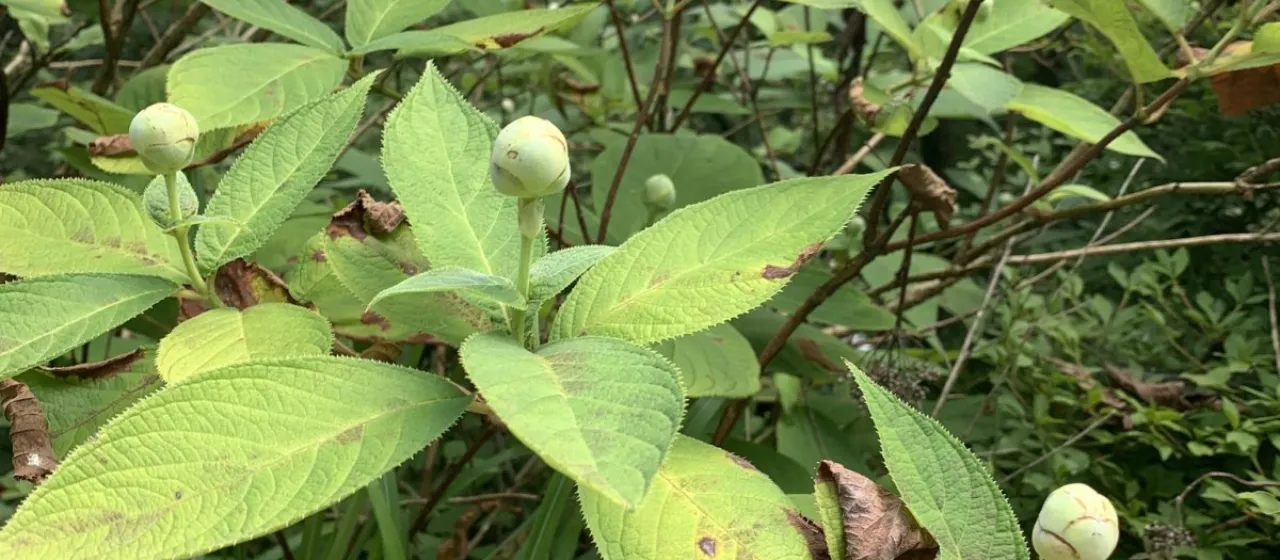
Description
Bracted hydrangea (lat. Hydrangea involucrata) is a deciduous perennial shrub belonging to the Hydrangeaceae family. It is distinct for its unique inflorescences, where developing flower buds are sheltered by large, overlapping bracts, which gives the plant its scientific and common names.
The species is native to the forest regions of Japan and Taiwan. Growing naturally in the understory of woodlands, it is well-adapted to environments with filtered light and high humidity. In agricultural and horticultural contexts, it is classified as a collector's ornamental shrub, prized for its subtle beauty and specific environmental requirements.
Botanically, it typically forms a low, compact bush, usually reaching between 1 to 1.5 meters in height. The foliage is relatively rough, providing a nice texture to the garden landscape. The flowers are produced on current-year wood, meaning that pruning should be handled carefully to avoid removing potential flower buds for the coming season.
Cultural requirements involve planting in areas with partial shade, as the leaves are sensitive to direct, scorching sun. The soil must be rich in organic matter, well-draining, and maintain an acidic to neutral pH level. Proper hydration is critical; the root system requires consistent moisture throughout the growing season to prevent leaf wilt.
- Light: Partial shade is essential for foliage health.
- Water: Constant moisture; never allow the soil to dry out completely.
- Soil: Humus-rich, acidic, well-drained substrate.
- Pruning: Light maintenance pruning in late winter or early spring.
Horticultural use is almost exclusively for ornamental purposes. It is an excellent choice for woodland gardens or shaded border arrangements. Common pests include aphids and spider mites, which can be managed with biological or systemic insecticides. Diseases are often related to moisture management, including gray mold (Botrytis) and powdery mildew, both of which can be mitigated with proper air circulation.