
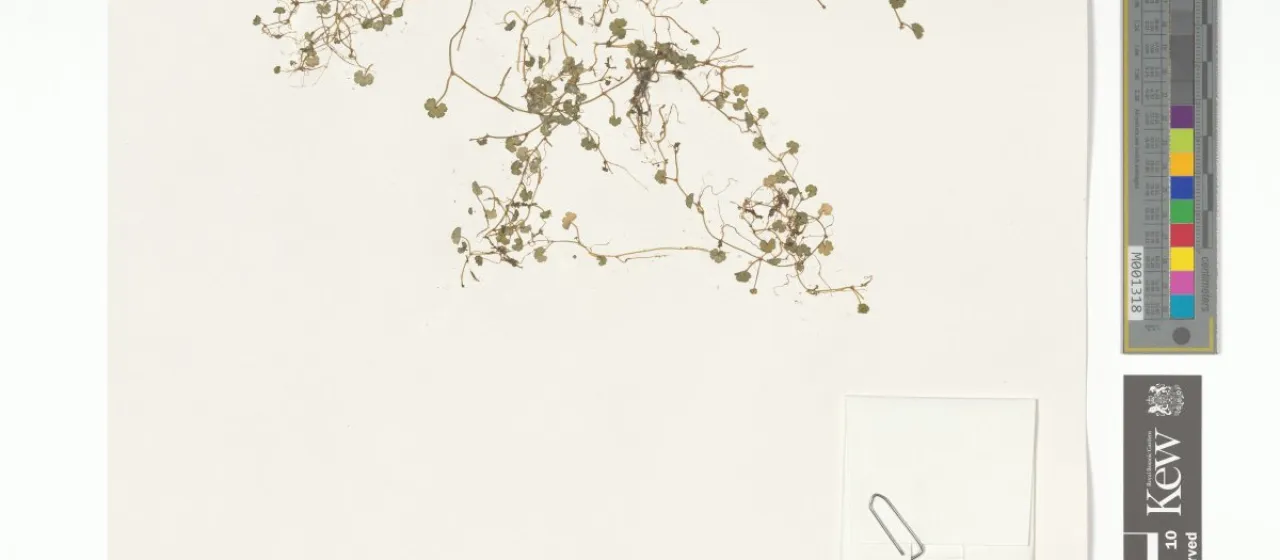
Description
Hydrocotyle dichondroides is a perennial herbaceous plant belonging to the Araliaceae family. It is a distinctive ground cover known for its low-growing, creeping habit, which makes it a versatile choice for both terrestrial landscaping in humid environments and aquatic settings in tanks or ponds.
The species originates from the tropical and subtropical regions of Asia. It thrives naturally in wet, shaded habitats, such as riverbanks, wetlands, and the edges of tropical forests. Its ability to adapt to high-moisture environments has made it a significant plant for horticulturists seeking reliable ground cover in challenging, damp conditions.
Botanically, the plant is characterized by thin, creeping stems that root easily at the nodes when in contact with moist substrate. The leaves are typically round or kidney-shaped with crenated margins, borne on slender petioles. Its rapid vegetative propagation allows it to form dense, lush mats that cover the surface of the soil or substrate efficiently.
For successful cultivation, the plant requires consistent moisture and moderate, filtered light. While it can tolerate a range of soil types, it performs best in rich, organic, slightly acidic, or neutral loamy soils. In container or aquatic setups, a nutrient-rich substrate is beneficial for long-term health, as it promotes vigorous growth and leaf expansion.
The main areas of хозяйственное (economic/practical) use include:
- Ground cover in landscape design for damp or shaded gardens.
- Aquascaping in the foreground of planted aquariums.
- Ornamental plant in paludariums and closed terrariums.
- Softening the edges of water features in garden design.
Regarding health and maintenance, the plant is generally robust but can be prone to fungal infections if humidity is too high without adequate air circulation. Snails and slugs are the primary pests that damage the foliage. Proper maintenance includes regular thinning of the plant mass and ensuring that the water quality remains high to prevent leaf decay.