
Description
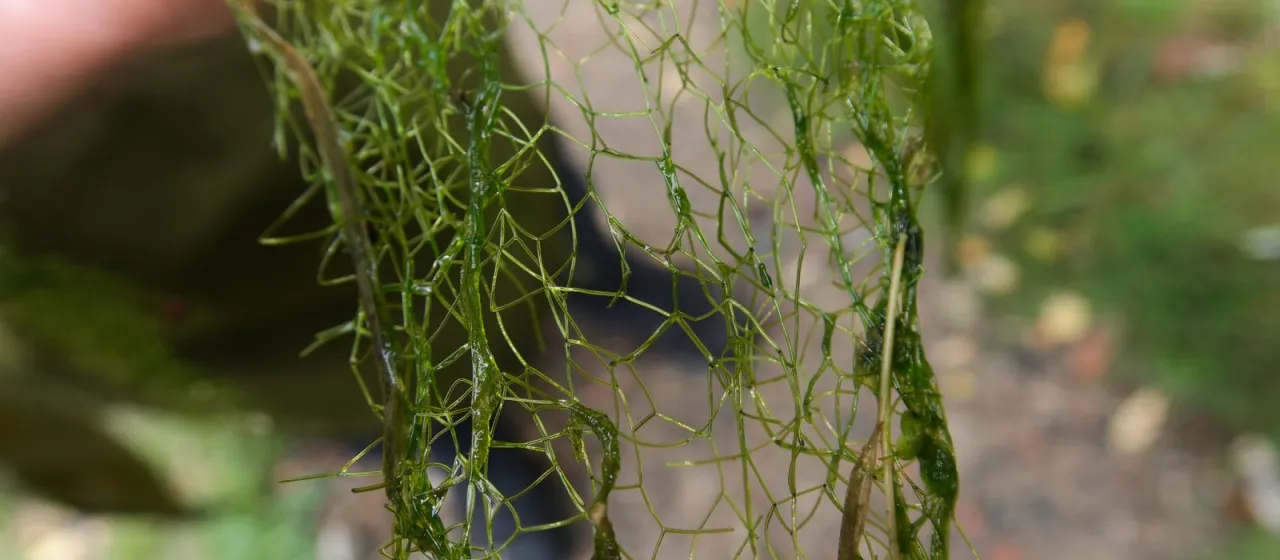
The water net (Hydrodictyon reticulatum) is a green alga belonging to the Hydrodictyaceae family. It is distinct for its colonial structure, where individual cells connect to form a macroscopic, hollow, net-like cylinder. These colonies can reach lengths of up to several dozen centimeters under favorable environmental conditions.
Native to various freshwater habitats globally, this species is frequently found in ponds, marshes, and irrigation channels. In agricultural contexts, Hydrodictyon reticulatum is often regarded as an invasive weed in managed water bodies, as its rapid proliferation can block irrigation systems and disrupt the oxygen levels required for aquaculture.
Botanically, the plant thrives in nutrient-rich (eutrophic) water. It reproduces both sexually and asexually, allowing for rapid colonization of new territories. The growth is highly dependent on light availability and water temperature, with peak development occurring during the spring and summer months in temperate regions.
Agricultural management of the water net primarily involves physical removal or the regulation of nutrient runoff from surrounding fields. Limiting nitrogen and phosphorus levels in irrigation water is the most effective preventative measure. While chemical algicides exist, their use is strictly regulated to ensure the safety of surrounding crops and aquatic life.
Beyond being an agricultural nuisance, the water net is studied for its bioremediation potential. Its ability to absorb excess nutrients makes it a candidate for wastewater treatment systems. Additionally, the harvested biomass is being investigated for its utility as a sustainable fertilizer or a raw material for biogas production in circular economy projects.
- Remarkable net-like colony morphology.
- Rapid vegetative expansion in eutrophic waters.
- Indicator species for high nutrient concentrations.
- Potential application in natural wastewater treatment.