
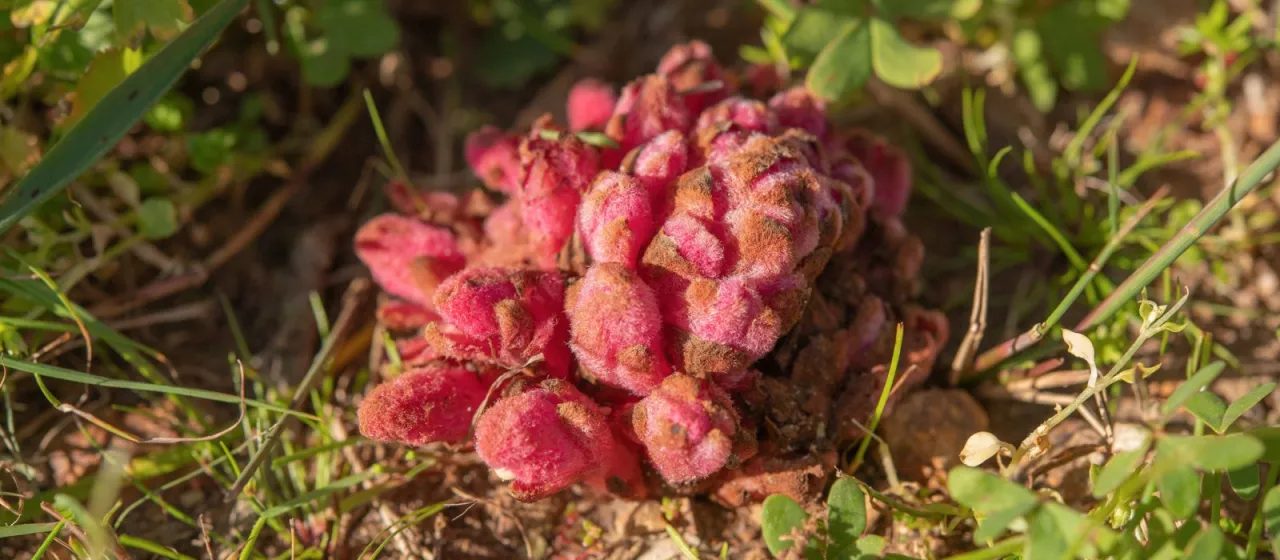
Description
Hyobanche sanguinea, commonly known as the red hyobanche or katstert, is a remarkable parasitic plant belonging to the Orobanchaceae family. As a holoparasite, it lacks chlorophyll and relies entirely on host plants for its nutritional needs, connecting its root system directly to the roots of its host to extract essential water and nutrients.
Native to the Western Cape of South Africa, this plant thrives in the unique environment of the fynbos biome. Its distribution is closely linked to the presence of host species, which typically include various shrubs from the Ericaceae, Asteraceae, and Fabaceae families. It is adapted to survive in sandy, nutrient-poor soils where host competition is intense.
The botany of this plant is defined by its striking appearance. The reproductive structures are fleshy, bright red spikes that emerge from the soil during the flowering season. These spikes are densely covered with scale-like leaves. The tubular flowers are specially adapted for pollination by nectar-feeding birds, which play a crucial role in the plant's life cycle.
In terms of agricultural utility, Hyobanche sanguinea is not a cultivated crop and has no commercial value in farming. It is strictly a wild species that is highly specialized for its native ecological niche. Because it relies on specific subterranean interactions with wild hosts, it cannot be grown using traditional agricultural techniques or conventional horticulture.
Management of this species is usually not required as it does not typically interfere with commercial agriculture. It does not suffer from standard crop pests or diseases in the same way as commercial plants, as its survival is intrinsically linked to the health of the host species it parasitizes within its indigenous environment.