
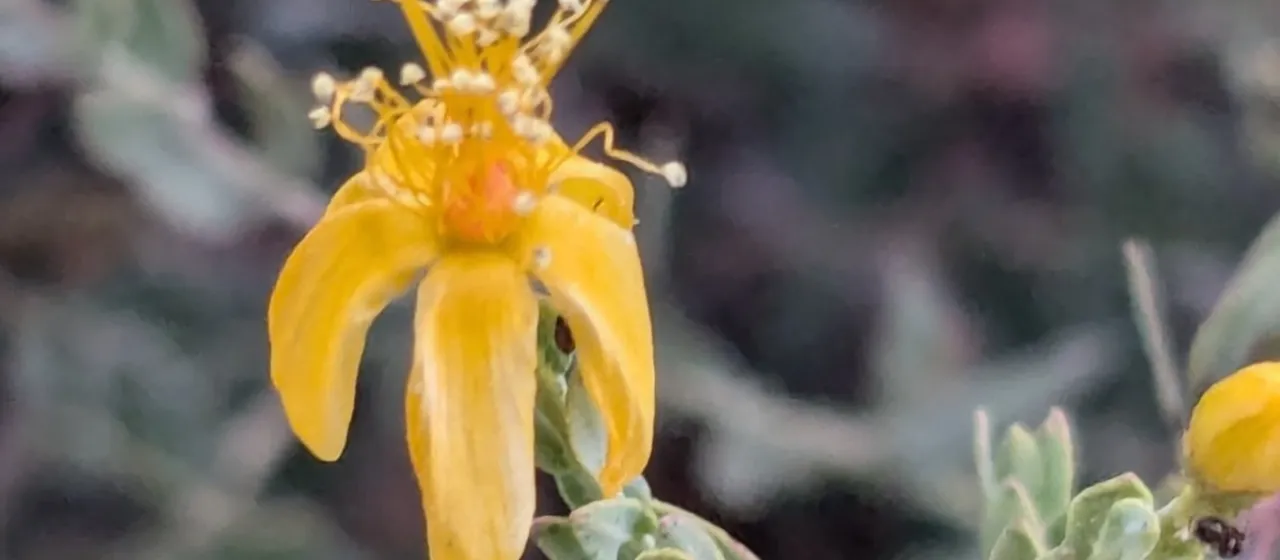
Description
Hypericum lanuginosum is a hardy perennial herbaceous plant belonging to the Hypericaceae family. It is distinct for its characteristic "woolly" (lanuginose) pubescence covering its leaves and stems, a morphological adaptation that allows it to thrive in harsh environments. This species is often overlooked but holds significant biological and aesthetic value in arid-region cultivation.
The plant originates primarily from the Mediterranean region and parts of the Near East. Its natural habitat consists of rocky slopes, limestone formations, and dry meadows with poor soil composition. This geographic distribution confirms its evolutionary preference for bright, open exposure and environments that receive high levels of solar radiation.
Botanically, it presents as a low-growing shrub or sub-shrub with opposite, densely pubescent leaves and typical bright yellow flowers with numerous stamens. The root system is deep and efficient at extracting nutrients from minimal sources. This robustness allows it to survive long periods of summer dormancy without rainfall, making it an excellent candidate for water-wise gardening.
Agricultural techniques for Hypericum lanuginosum revolve around the principle of minimal interference. It requires extremely well-draining soil, ideally of a sandy or gravelly texture, to prevent root rot. Nitrogen-rich fertilizers are unnecessary and can even be detrimental, as the plant prefers nutrient-poor substrate. Pruning after the flowering cycle encourages denser growth and more vibrant blooms the following season.
In terms of хозяйственное (economic) use, the plant is primarily harvested for botanical research, niche herbal pharmaceutical applications, and professional landscaping. It is highly valued in Mediterranean-style gardens where water conservation is a priority. Despite its resilience, farmers should monitor for potential infestations of aphids or spider mites, which can sometimes target the softer tissue during moist spring weather.
- Excellent drought tolerance.
- Prefers rocky and well-drained substrates.
- High aesthetic value for rock gardens.
- Low fertilization requirements.