
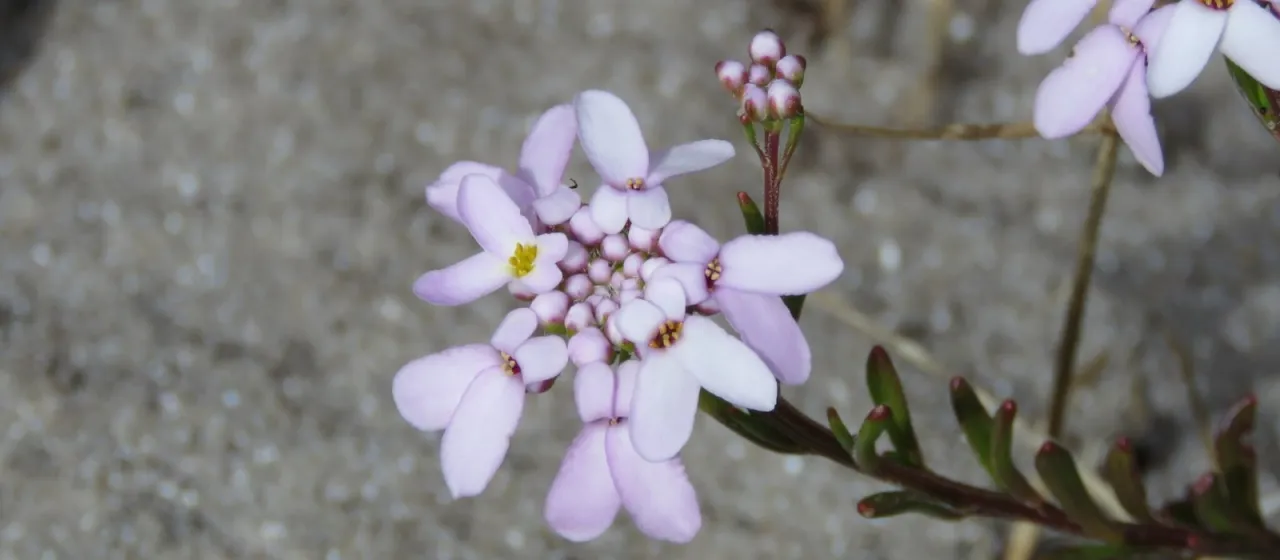
Description
Iberis procumbens, commonly known as the procumbent candytuft, is a perennial herbaceous plant belonging to the Brassicaceae family. This species is highly valued in horticulture for its prostrate growth habit, which allows it to form dense, mat-forming colonies that stay close to the ground.
The plant originates from the Western Mediterranean region, specifically thriving in the rocky and mountainous terrains of the Iberian Peninsula. Its evolutionary history in such demanding environments has equipped it with significant drought tolerance and the ability to flourish in thin, stony, or calcareous soils where other plants might struggle.
Botanically, it features semi-woody stems and small, narrow, evergreen leaves that provide texture even when the plant is not in flower. The inflorescences are dense, flat-topped racemes composed of white or light pink flowers that appear in late spring and early summer, creating a vibrant display of color against the dark foliage.
Cultivation requirements focus on providing full sun and excellent drainage. The plant is sensitive to "wet feet," meaning that waterlogged soil will quickly lead to root decay. Gardeners should plant it in porous soil mixes, preferably in rock gardens or raised beds, and provide moderate water only during the initial establishment period.
In terms of agricultural and landscape use, Iberis procumbens serves as an excellent groundcover for rock gardens, stone walls, and gravel pathways. It is relatively resistant to major pests, although like other members of the mustard family, it can be susceptible to aphids or crucifer flea beetles if conditions are not ideal. Maintenance is simple, requiring only light trimming after flowering to maintain a compact shape.