
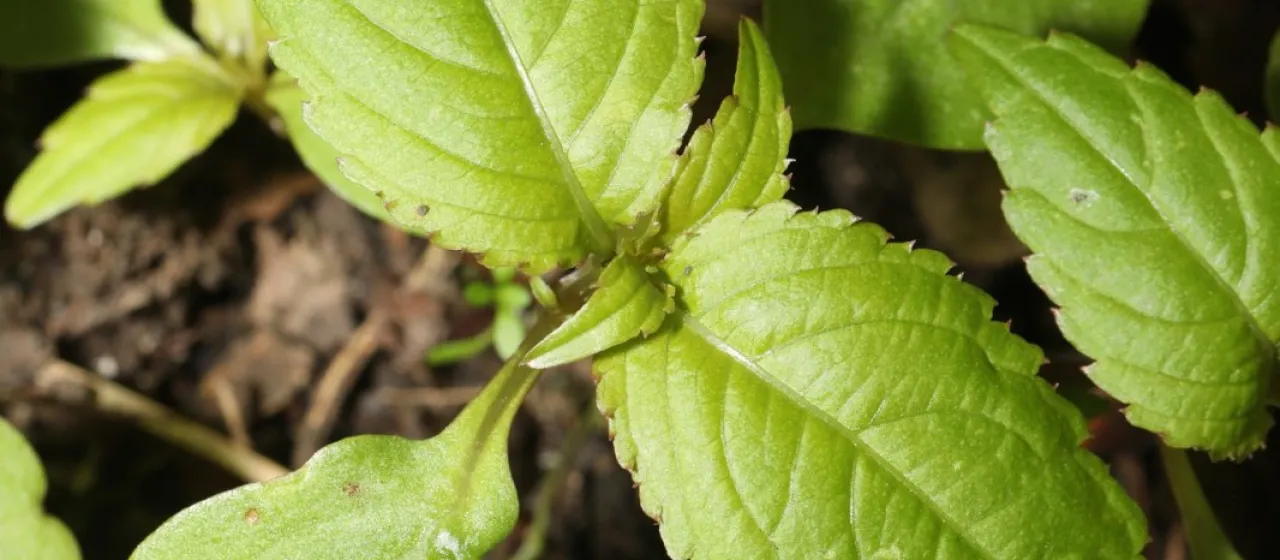
Description
Small balsam (Latin: Impatiens parviflora) is an annual herbaceous plant belonging to the Balsaminaceae family. While not an agricultural crop, it is widely recognized as an invasive weed species that poses challenges to forest management, gardening, and sometimes specific agricultural areas characterized by high humidity and shade.
The native range of this species covers Central Asia, specifically the mountain regions of Siberia and Kazakhstan. During the 19th century, it was introduced to Europe as an ornamental plant, after which it successfully naturalized and began rapidly spreading across the continent, adapting to diverse environmental conditions.
Botanically, the plant is characterized by a succulent, fragile stem that grows up to 80 cm tall, with alternate, elliptical leaves. Its small, pale yellow flowers are arranged in clusters. A defining biological trait of the plant is its explosive seed dispersal mechanism, where mature fruit capsules dehisce violently upon contact, launching seeds several meters away to ensure efficient propagation.
The plant thrives in moist, shaded environments, such as woodlands, forest edges, and shaded agricultural zones. It prefers nutrient-rich, well-drained soils. Because it is highly shade-tolerant, it can colonize areas where other vegetation struggles, often becoming a dominant undergrowth species that hinders natural forest regeneration and interferes with local crop management.
To effectively manage and control Small balsam, the following agricultural and horticultural strategies are recommended:
- Manual removal and weeding before the formation of mature seed capsules.
- Regular mowing of affected areas to exhaust the soil seed bank over time.
- Improving light penetration in shaded zones to reduce the plant's competitive advantage.
- Monitoring of riparian zones and shaded forest-field borders to prevent further spread.