
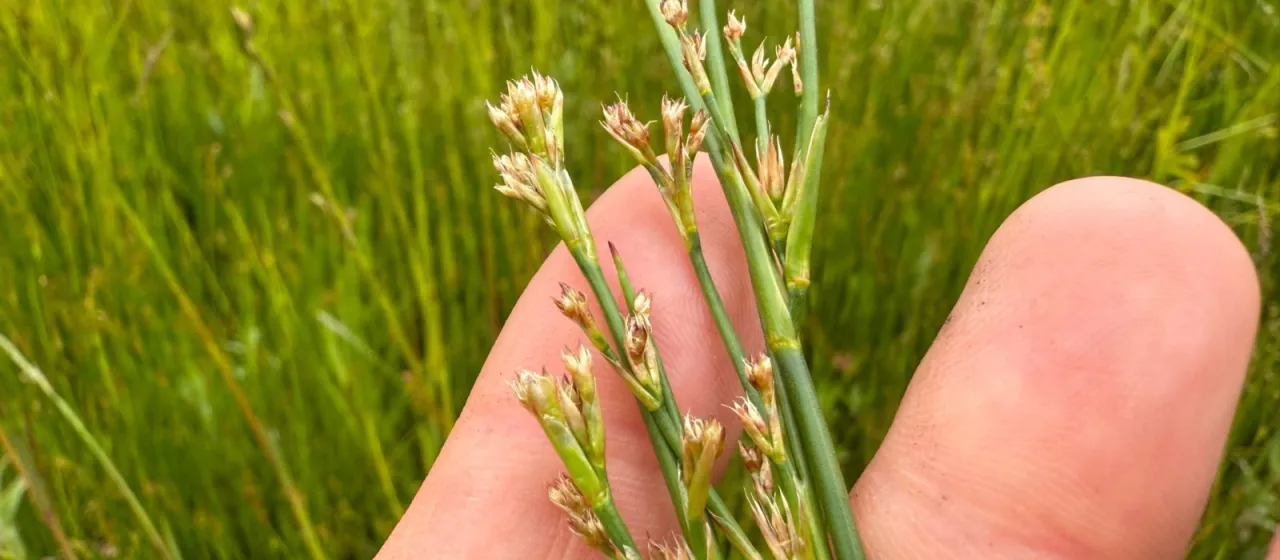
Description
The blunt-flowered rush (Juncus subnodulosus) is a perennial herbaceous plant belonging to the Juncaceae family. Within agricultural and ecological contexts, it is recognized as a hardy plant species that thrives in water-saturated environments where typical field crops are unable to establish themselves successfully.
This species is native to large parts of Europe and Western Asia. It is commonly found in wetlands, marshy grasslands, and the banks of irrigation ditches or natural water bodies. The plant exhibits a high degree of tolerance to hydromorphic soils, preferring environments with constant high moisture and organic nutrient availability.
Botanically, Juncus subnodulosus features a rhizomatous root system and cylindrical stems that can grow up to one meter in height. Its most distinguishing feature is the internal structure of its leaves, which contain distinct transverse septa, giving them a nodulated or jointed appearance, which is the primary trait used for botanical identification.
The agronomic management of this species is largely based on ecological land restoration. Unlike traditional crops, the blunt-flowered rush requires no intensive fertilization or tillage. It propagates efficiently through rhizome spreading, which allows it to form dense colonies that are highly effective at binding soil and protecting riparian areas from hydraulic erosion.
In terms of хозяйственное usage, the blunt-flowered rush is increasingly valued for bio-remediation projects and the stabilization of embankments. While it is rarely used as fodder due to its toughness, its ecological significance as a habitat builder and its role in nutrient cycling in wetlands make it a beneficial species in sustainable land management strategies.
- Excellent soil binder for wet areas.
- High tolerance to flooding and hypoxia.
- Natural tool for riparian zone protection.
- Essential for wetland biodiversity.