Nelson's kniphofia
Kniphofia nelsonii Mast.
Description
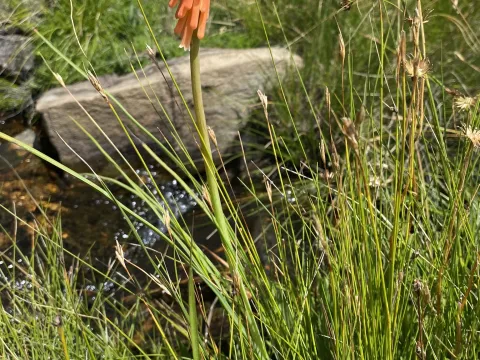
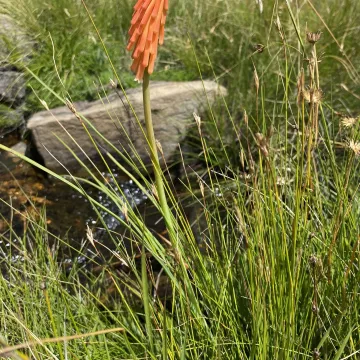
Nelson's kniphofia (Kniphofia nelsonii Mast.) is a perennial herbaceous crop belonging to the Asphodelaceae family. It is a compact, rhizomatous plant known for its striking, candle-like inflorescences that add a unique architectural element to any planting scheme.
The plant originates from the mountainous regions of South Africa, where it thrives in well-drained slopes and meadows. Today, it is widely cultivated in temperate regions across the globe as a popular ornamental plant, valued for its ability to bring an exotic, vibrant aesthetic to various garden styles.
Botanically, this species is characterized by grass-like basal leaves that form dense clumps. Its flowers are tubular and arranged in dense racemes at the top of long stalks. The distinct orange or coral coloration of the florets is a key feature that provides significant nectar, making it attractive to local pollinating insects.
Success in cultivating Kniphofia nelsonii requires full sun exposure and fertile, well-draining soil. It is crucial to prevent waterlogging, especially during dormancy, as the roots are susceptible to rotting. Maintenance involves moderate watering during the growing season and periodic fertilization to support the prolific flowering cycle.
In terms of agricultural and horticultural use, it is primarily grown for ornamental purposes. It is commonly used in rock gardens, mixed borders, and as a focal point in landscapes. Professional florists also prize the species for its longevity as a cut flower in floral arrangements.
The plant can be susceptible to several issues if the environment is not optimized:
- Root rot caused by poorly drained or overly saturated soil.
- Infestations by aphids or spider mites, particularly in hot, dry summers.
- Winter kill if protection or mulch is not provided in colder climates.
Photo gallery