
Description
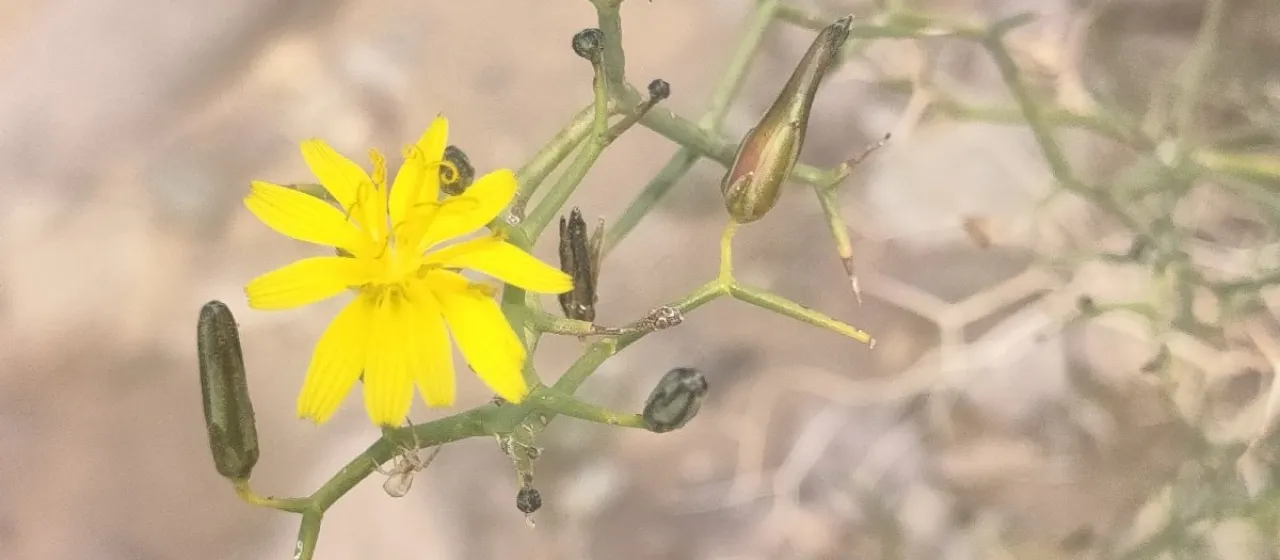
Launaea arborescens is a woody perennial shrub belonging to the Asteraceae family. Known for its resilient and dense growth habit, it is specifically adapted to survive in harsh arid environments. The plant is characterized by its stiff, often thorny branches which serve as a mechanism to minimize water loss and protect against herbivory in its native habitat.
The species is indigenous to the dry regions of North Africa, the Canary Islands, and parts of Southwest Asia. It typically thrives in sandy, stony, or saline soil conditions where annual precipitation is very low. Its presence is vital in these landscapes, as it acts as a stabilizing element for shifting sands and sparse desert soils.
Botanically, Launaea arborescens exhibits a deep taproot system designed to reach groundwater in arid zones. Its leaves are usually small and reduced, helping to optimize water usage. The plant blooms with bright yellow flower heads, attracting pollinators such as bees and desert butterflies, which is essential for the reproduction of local desert flora.
Agricultural practices for this plant are minimal, focusing mostly on its utility in environmental conservation. It requires well-draining soil and plenty of direct sunlight. As a plant suited for extreme climates, it shows poor adaptation to temperate or high-humidity zones. Propagation is generally achieved via seeds or stem cuttings, requiring care to ensure proper root development.
Economically, the plant is primarily utilized for land reclamation and soil stabilization. By creating windbreaks, it helps prevent desertification in sensitive agricultural areas. Furthermore, the foliage provides essential fodder for camels and goats during drought periods when other vegetation is unavailable. Ongoing research explores its chemical compounds for potential industrial and medicinal applications.
- Extreme drought and salt tolerance
- Essential for desert soil stabilization
- Source of forage for livestock in arid regions
- Low maintenance requirements in suitable climates