
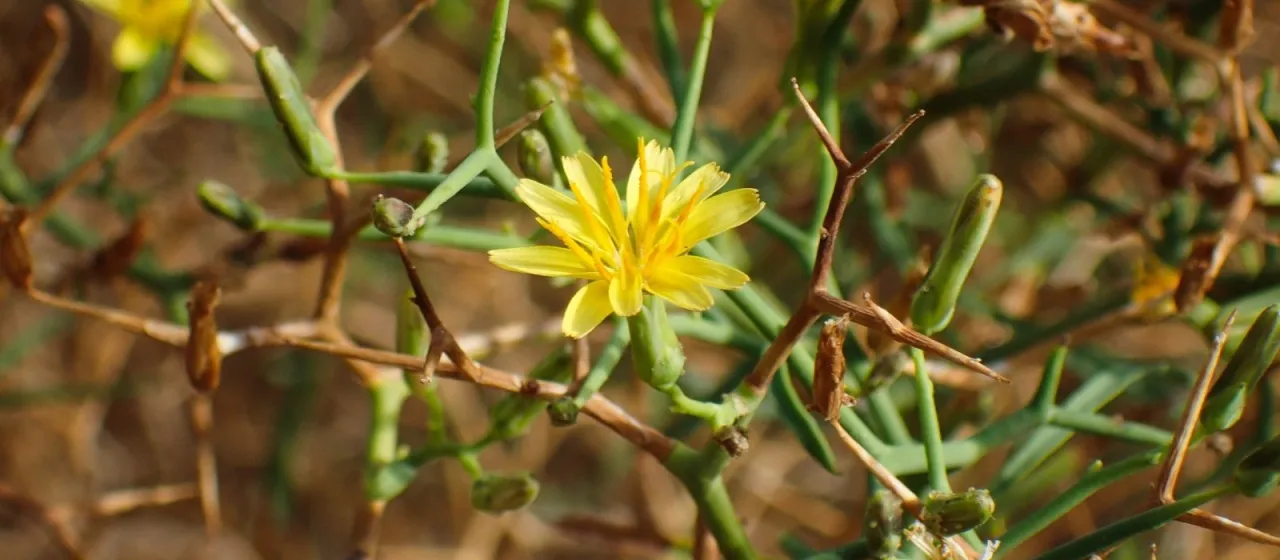
Description
Launaea spinosa is a perennial semi-shrub belonging to the Asteraceae family. This species is highly specialized for life in harsh arid and semi-arid environments, demonstrating exceptional physiological adaptations to drought and extreme thermal fluctuations found in desert ecosystems.
The plant originates from regions across Northern Africa and Western Asia. Its natural habitat includes rocky plateaus, sand dunes, and salt-affected flats. Due to its wide distribution in such environments, Launaea spinosa serves as a critical component of the local vegetation, providing ecological stability in degraded landscapes.
Botanically, the plant is characterized by a branched, woody structure with rigid, thorn-like stems. These spines serve as an effective mechanism to reduce water loss and protect the plant from herbivores. The root system is extensive and deep, allowing the plant to reach deep soil moisture reservoirs that are inaccessible to shallower-rooted flora.
In terms of cultivation, this species demands well-drained, sandy soils with low nutrient requirements. It is highly sensitive to waterlogged conditions, which can lead to rapid decay of the root collar. The plant is drought-tolerant and thrives in full sun exposure, making it suitable for low-input management in arid landscape restoration projects.
The primary economic use of this plant is as a source of forage for camels and small livestock in desert pastures where other vegetation is scarce. It also aids in soil stabilization. While generally robust, the plant can be affected by specific fungal pathogens if the soil aeration is poor, and occasional damage from subterranean pests can occur in disturbed sandy soils.