
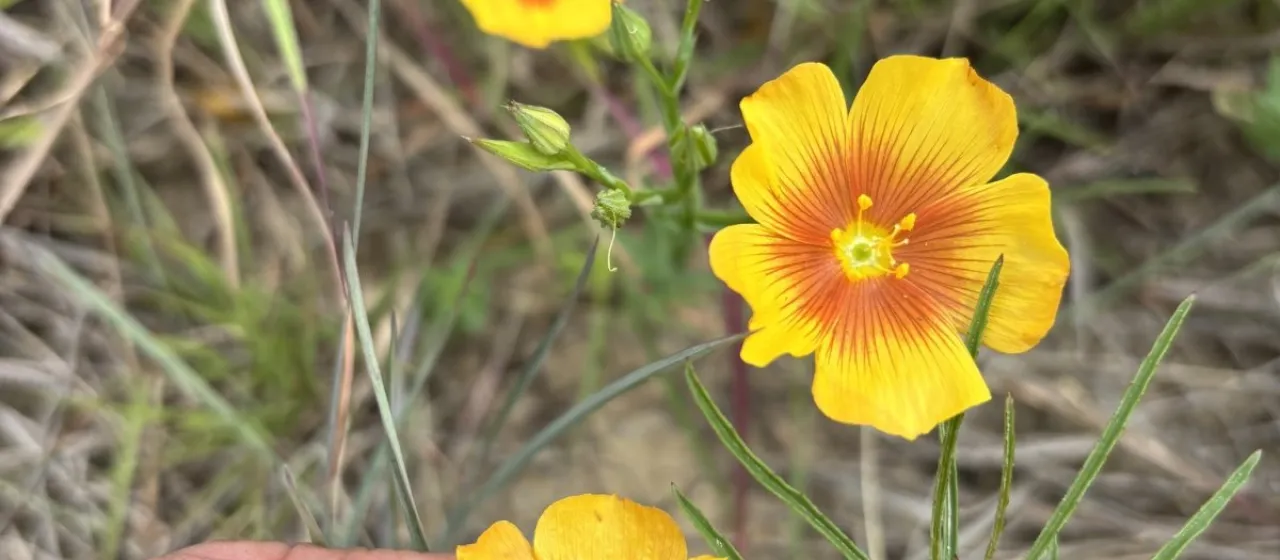
Description
Stiffstem flax (lat. Linum rigidum) is a perennial herbaceous plant belonging to the Linaceae family. It is a distinct species known for its resilience and ability to thrive in harsh environments, particularly in regions where moisture availability is the limiting factor for plant growth.
The plant is native to the arid and semi-arid regions of North America, particularly the Great Plains. It is commonly found in dry grasslands, prairies, and rocky slopes. Its natural range demonstrates its exceptional capacity to adapt to environments with high temperatures and periodic drought stress.
Botanically, it is defined by its stiff, erect, and often branched stems, which carry narrow leaves. One of the most notable features is its yellow flowers, which set it apart from the common blue-flowering Linum usitatissimum. The plant produces small, hard capsules containing seeds adapted for survival in unpredictable climates.
From an agronomic perspective, Linum rigidum favors well-drained, porous soils, including sandy or calcareous types. It is highly sensitive to soil compaction and waterlogging. Effective management of this species in its natural range involves minimal soil disturbance and the maintenance of native herbaceous layers to prevent weed encroachment.
- Requires high levels of sunlight for optimal development.
- Exhibits high tolerance to nutrient-poor soils.
- Susceptible to root rot if soil drainage is inadequate.
- Can be affected by generalist pests common to wild herbaceous plants.
While this plant is not a commercial crop for fiber or linseed oil, its ecological value is significant. It serves as a vital component of prairie biodiversity. Furthermore, plant breeders look at Linum rigidum as a genetic reservoir, potentially harboring traits for drought and heat resistance that could be utilized to improve the resilience of cultivated flax varieties.