
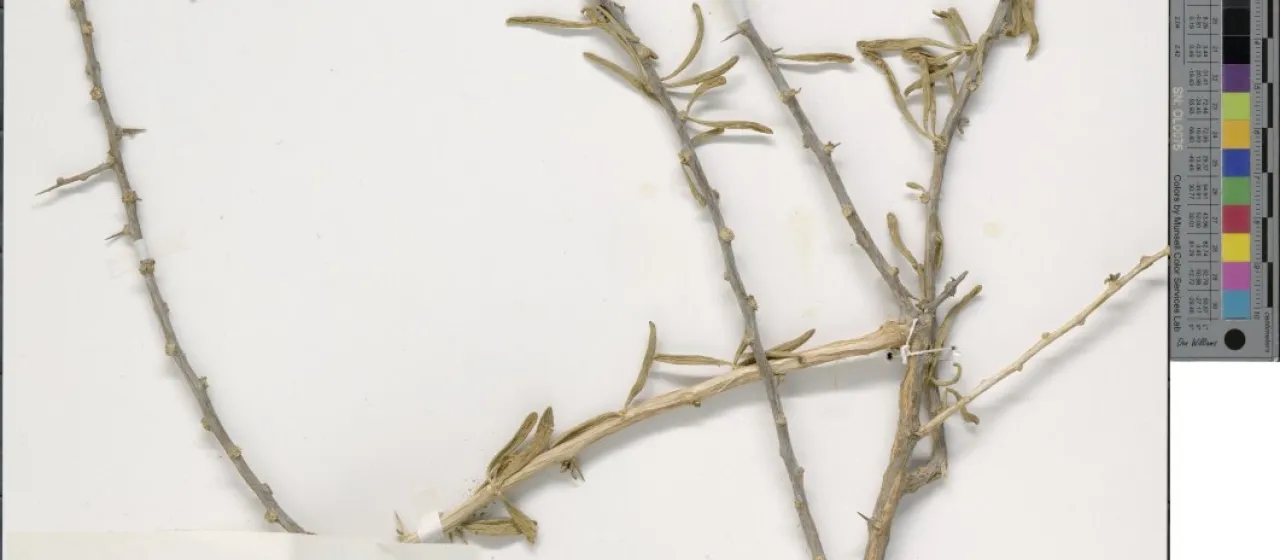
Description
Turkmen boxthorn (Lycium turcomanicum) is a perennial thorny shrub belonging to the Solanaceae family. It is a highly resilient species specifically adapted to the arid and semi-arid climates of Central Asia, where it thrives under conditions of extreme heat and minimal precipitation.
The native distribution area of this species is centered in Turkmenistan and adjacent regions, where it frequently grows in saline soils, sandy deserts, and floodplains. Its presence is vital for the stability of local ecosystems, particularly in environments prone to desertification where few other woody plants can survive.
Botanically, Lycium turcomanicum is characterized by dense, spiny branches and small, greyish-green leaves that have adapted to reduce transpiration. The plant produces tubular flowers, typically shades of violet or white, followed by small berries. Its root system is extensive, allowing it to tap into deep soil moisture reserves, which is a key survival strategy in its natural habitat.
Regarding cultivation requirements, the plant is undemanding and thrives in full sun. It prefers well-drained, alkaline or saline soils. Agricultural management is minimal, focusing primarily on establishment during the first year and occasional pruning to manage growth density. It is highly resistant to drought and can withstand harsh wind conditions that would desiccate more sensitive crops.
The economic and agricultural utility of the Turkmen boxthorn is primarily found in environmental engineering. Its major roles include:
- Stabilization of sandy soils and prevention of wind erosion.
- Establishment of living fences or windbreaks in desert landscapes.
- Traditional herbal medicinal applications of the fruit and foliage.
- Provision of a hardy forage source for camels and other livestock in harsh regions.
In terms of plant protection, the species is relatively robust against typical agricultural pests, though it may occasionally host aphids or mites common to the Solanaceae family. Disease outbreaks are generally non-existent in its natural range, as the plant is highly adapted to the specific ecological niche it occupies, making it an excellent candidate for low-input desert agriculture.