
Description
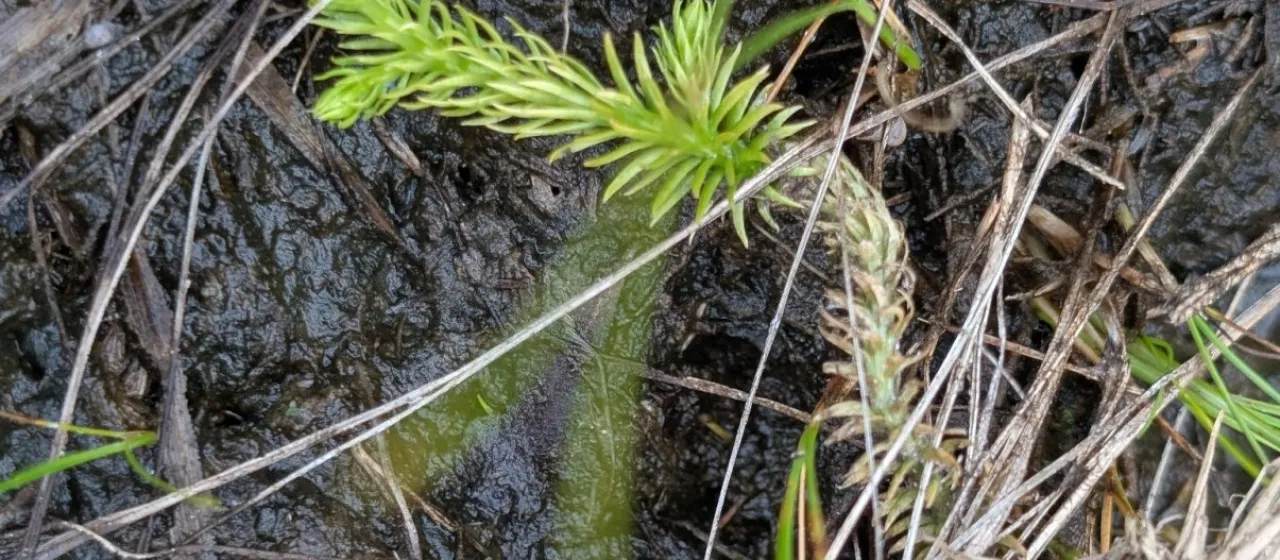
Marsh clubmoss (Lycopodiella inundata) is a perennial, spore-bearing herb belonging to the Lycopodiaceae family. Unlike common forest clubmosses, this species is specialized for life in wet, open habitats that are subject to seasonal flooding and water level fluctuations.
The plant has a circumboreal distribution, native to temperate regions of Europe, Asia, and North America. It is typically found in nutrient-poor, acidic soils, such as wet sandy shores, lake margins, and disturbed boggy areas where it can establish without competition from larger vascular plants.
Botanically, the plant consists of a creeping, rooting stem that spreads across the substrate. It produces upright, fertile shoots which terminate in a single, distinct strobilus. The foliage is characteristically narrow and tightly packed along the stems, reflecting its adaptation to both aquatic and terrestrial life phases.
Cultivation requirements for this species are strict, as it is difficult to maintain in standard agricultural settings. It necessitates acidic, moisture-retentive substrate, typically pure peat or wet sand, and a high-humidity environment. Successful propagation is usually achieved by division of the creeping rhizomes under greenhouse conditions.
Economically, marsh clubmoss is not a crop in the traditional sense, but it is of high interest for ecological restoration projects and specialized botanical gardens. In many parts of its range, it is considered a protected or threatened species, and conservation efforts are focused on preserving its natural microhabitats.