
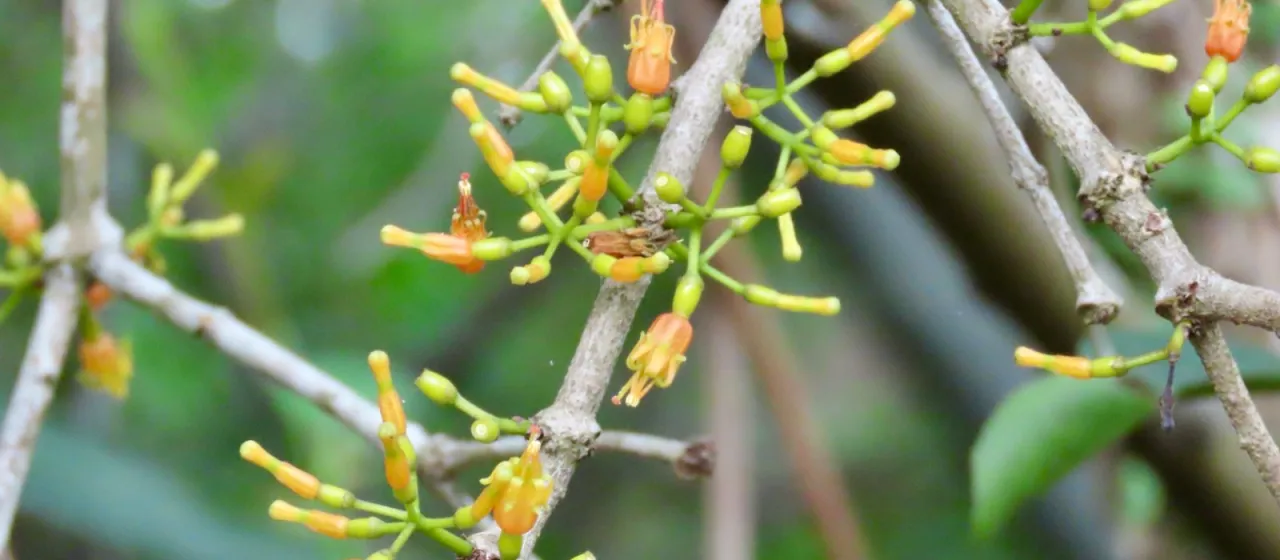
Description
Macrosolen ampullaceus is a species of hemiparasitic plant belonging to the Loranthaceae family. While not an agricultural crop in the traditional sense, it is a significant organism in tropical ecology, often interacting with various tree species by anchoring itself in their branches to extract essential nutrients and water.
The native range of this species extends across the tropical regions of South and Southeast Asia, including countries like Malaysia, Indonesia, and India. It thrives in high-humidity environments typical of tropical rainforests, where it colonizes host trees that provide the necessary structural support and hydraulic access for its survival.
Botanically, it is characterized by succulent, leathery leaves and distinctive tubular flowers. Its root system is highly adapted into haustoria, which penetrate the host's xylem and phloem tissues. This adaptation allows the plant to efficiently siphon resources from the host tree while maintaining its own photosynthetic capabilities.
Ecological requirements are strictly tied to tropical climate conditions, emphasizing the need for high relative humidity and constant temperatures. As an epiphyte, it has no direct soil requirement. The life cycle depends on avian seed dispersal, where birds consume the fruits and deposit seeds onto the branches of suitable host trees.
- Requires established tropical tree hosts.
- Dependent on nectar-feeding birds for pollination.
- Susceptible to physiological changes in host trees.
- Can impact the yield of fruit orchards if left unmanaged.
In human terms, its management is strictly focused on mitigation in orchards or forest plots where it might cause excessive stress to economic tree species. While it does not face typical crop pests, it can be affected by specific fungal pathogens that weaken the haustorial connection between the parasite and its host.