
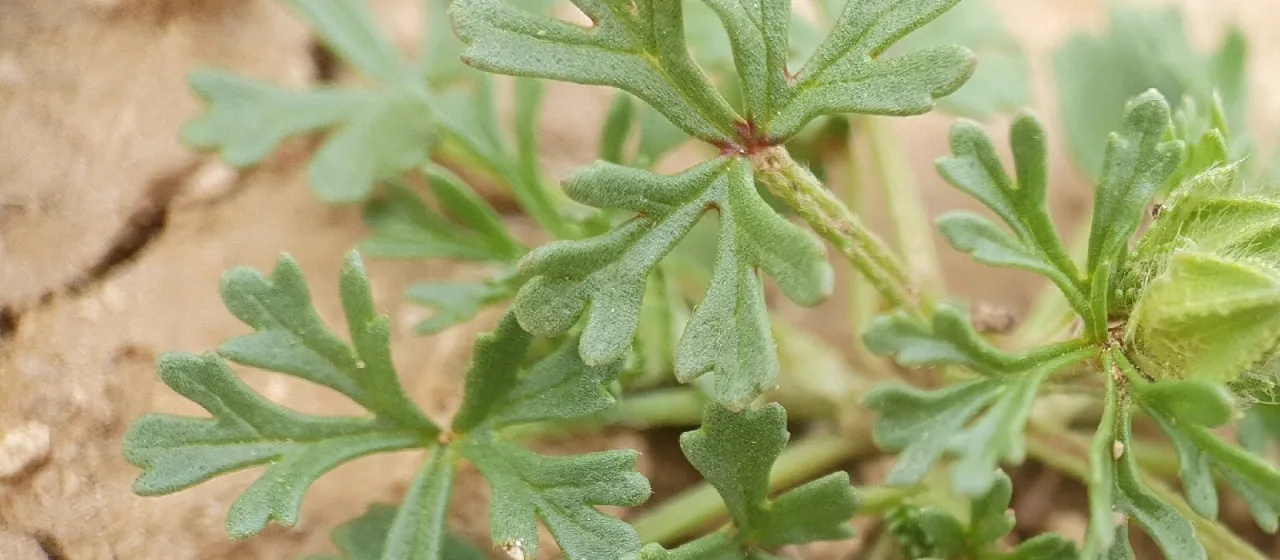
Description
Egyptian mallow (Malva aegyptia) is an annual herbaceous plant belonging to the Malvaceae family. This species is recognized for its physiological adaptation to arid and semi-arid environments, making it a subject of interest for agricultural research in regions facing increasing desertification.
Originating from North Africa and the Middle East, the plant has a natural distribution centered in warm, dry climates. Its capacity to thrive in harsh, low-rainfall conditions defines its primary role as a potential crop for sustainable agriculture in challenging geographies.
Botanically, the plant presents with a pubescent, often branched stem and small, deeply lobed leaves. The flowers are relatively small, appearing in the leaf axils, and serve as an efficient source of reproduction in nutrient-poor environments. Its root system is significantly developed to maximize water extraction from deeper soil layers.
Cultivation requirements favor well-drained, sandy, or light loamy soils. The plant demonstrates high tolerance to salinity, which is a crucial trait for land management in regions where soil degradation due to salt accumulation is a primary concern. Adequate sunlight exposure is essential for its development and biomass accumulation.
The main agricultural usage of Egyptian mallow is as a forage supplement for livestock in arid regions. Its role as a soil stabilizer on marginal lands is also being investigated. Common threats include:
- Rust fungi (Puccinia spp.)
- Aphids (Aphididae)
- Spider mites (Tetranychidae)
- Root rot pathogens in waterlogged soils