Mammillaria bombycina
Mammillaria bombycina
Description
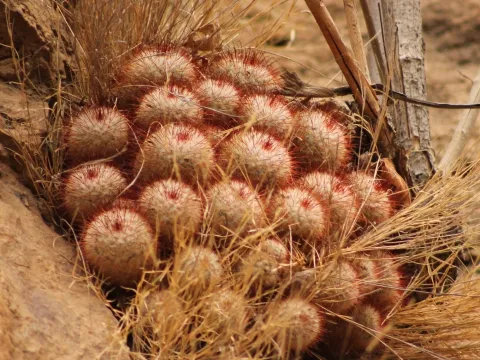
Mammillaria bombycina is an attractive species of succulent belonging to the Cactaceae family. Known in the botanical community for its dense, silky spines and clustered growth habit, it is considered a classic specimen for cactus enthusiasts who appreciate plants with complex geometric textures.
Native to the central mountainous regions of Mexico, this species thrives in rocky crevices and well-drained slopes. Its evolution in a semi-arid, high-altitude environment has equipped it with a high tolerance for drought and a requirement for significant solar exposure to maintain its characteristic compact form and dense spination.
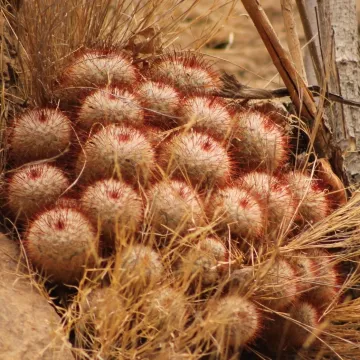
Botanically, it is classified by its cylindrical to spherical stems that offset to form large, dense mounds over time. The radial spines are translucent white and delicate to the touch, while the central spines are slightly sturdier. It typically blooms during the spring season, producing small but vivid, deep pink flowers that emerge in a halo pattern around the crown of the plant.
Cultivation requirements focus on mimicry of its natural rocky habitat. The substrate must be exceptionally porous, typically consisting of pumice, perlite, and a small percentage of grit or coarse sand. Irrigation should be restricted to the growing season, applied only when the substrate has completely dried out, while winter dormancy requires total dryness and cool temperatures to stimulate subsequent flowering.
This species is widely used in commercial nursery production for ornamental purposes, ranging from small-scale indoor pots to large professional greenhouse collections. Growers must stay vigilant regarding common cultural pitfalls, which include the following:
- Root rot caused by stagnant moisture in the substrate.
- Etiolation resulting from insufficient direct sunlight.
- Mealybug infestations that hide in the dense spine canopy.
- Fungal infections triggered by poor air circulation.
Photo gallery