
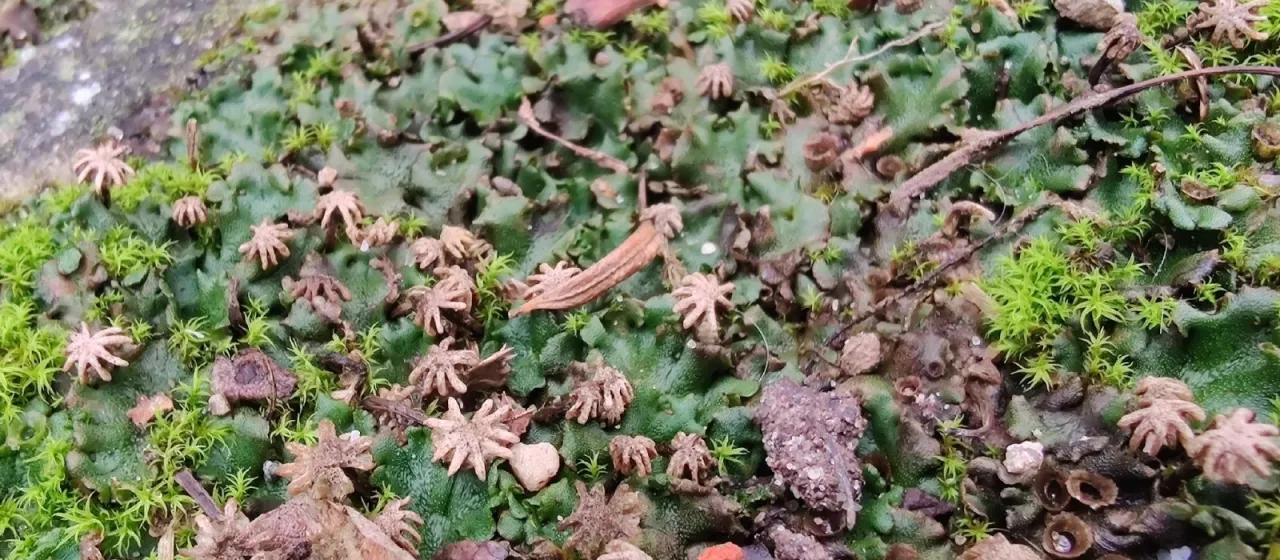
Description
Marchantia polymorpha, widely known as the common liverwort, is a member of the Marchantiaceae family. As one of the most recognizable bryophytes, this plant lacks a vascular system and complex organs, instead consisting of a flat, thalloid structure that serves as a fundamental example of early terrestrial plant life.
The distribution of this species is nearly cosmopolitan, appearing in a diverse array of environments ranging from disturbed urban sites to pristine woodland floors. Its ability to tolerate varying moisture levels and colonize burnt or bare soil makes it an effective pioneer species in primary succession across many ecological zones.
Botanically, the plant is characterized by a dichotomously branched thallus with distinct internal structures, including air chambers and pores for gas exchange. Its reproductive cycle involves both sexual reproduction through gametangiophores and efficient asexual propagation via gemmae, which are housed in specialized cup-shaped structures called gemma cups.
Cultivation requires specific environmental control, particularly high humidity and low-to-moderate light intensity. Soil requirements are minimal, as the organism derives moisture primarily from the air and substrate surface. In controlled settings, it thrives on peat-based media or inert agar gels, which must be kept free of competitive fungi and algae.
Economically and scientifically, Marchantia polymorpha is highly valued as a premier model organism in plant developmental biology and genetic research. Its simple genome, ease of transformation, and rapid life cycle enable researchers to study gene function and cellular processes, contributing significantly to advancements in plant biotechnology and metabolic engineering.
- Asexual reproduction through gemmae cups.
- High moisture and humidity requirements.
- Excellent model for genomic studies.
- Sensitivity to air pollutants and toxins.