
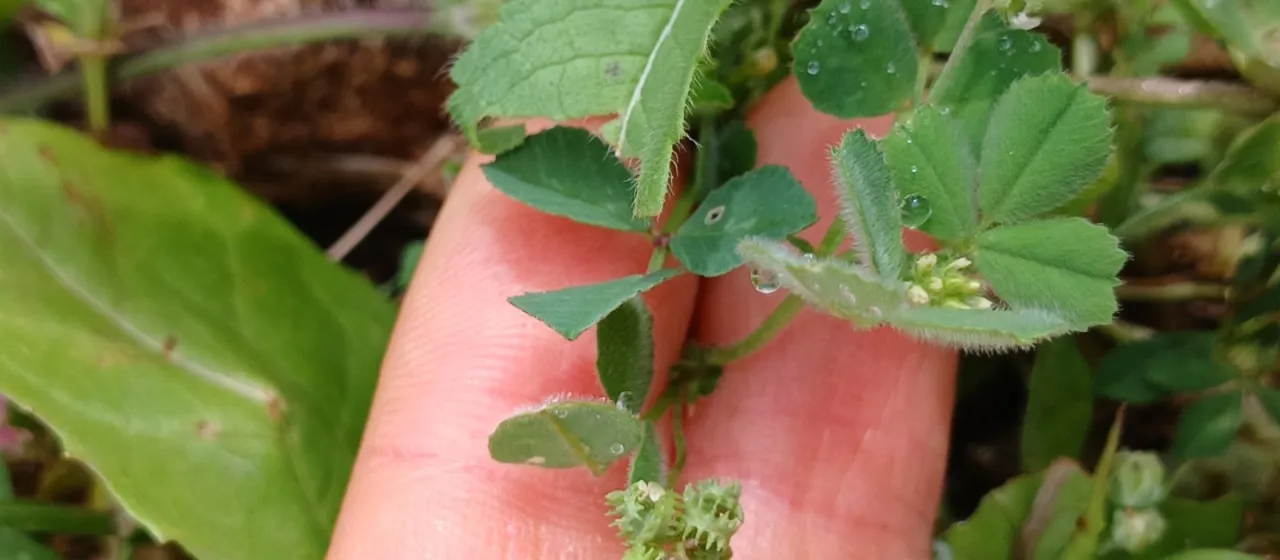
Description
Crown medic (Medicago coronata) is an annual herbaceous plant belonging to the legume family (Fabaceae). This species is well-known for its unique fruit shape, which features crown-like projections, giving it its distinct botanical name. As a member of the Fabaceae family, it plays a vital role in soil health through its ability to engage in nitrogen fixation via symbiotic bacteria.
The plant originates from the Mediterranean basin, spanning across Southern Europe, Northern Africa, and Western Asia. In these regions, it is frequently found in arid and semi-arid habitats, demonstrating a remarkable ability to survive in environments where other fodder crops might fail. Its natural resilience has made it a subject of interest for forage production in Mediterranean-climate zones.
Botanically, crown medic is characterized by its branching stems and trifoliate leaves, topped with small, bright yellow flowers. Its most distinct feature is the coiled, toothed legume pod. The root system is generally deep and fibrous, allowing the plant to draw moisture from deeper soil horizons during periods of low rainfall, which ensures stable growth even in less-than-ideal conditions.
When it comes to cultivation requirements, crown medic prefers well-drained, slightly alkaline soils. It is highly intolerant of waterlogged conditions, which can lead to root rot. Successful agricultural management requires appropriate site selection with full sun exposure and a relatively simple seeding process, as the plant establishes itself well once the soil temperatures are conducive to germination.
The primary economic use of crown medic is as a nutritious fodder for livestock, particularly sheep and goats, due to its high protein content. Beyond fodder, it is highly regarded in sustainable agriculture for its soil-improving properties. By accumulating nitrogen in the soil, it serves as an excellent natural fertilizer for subsequent crops, reducing the need for synthetic nitrogen inputs in crop rotation systems.
- High drought tolerance and adaptability.
- Significant soil nitrogen enrichment capabilities.
- High-quality protein source for livestock forage.
- Low input requirements for field management.